
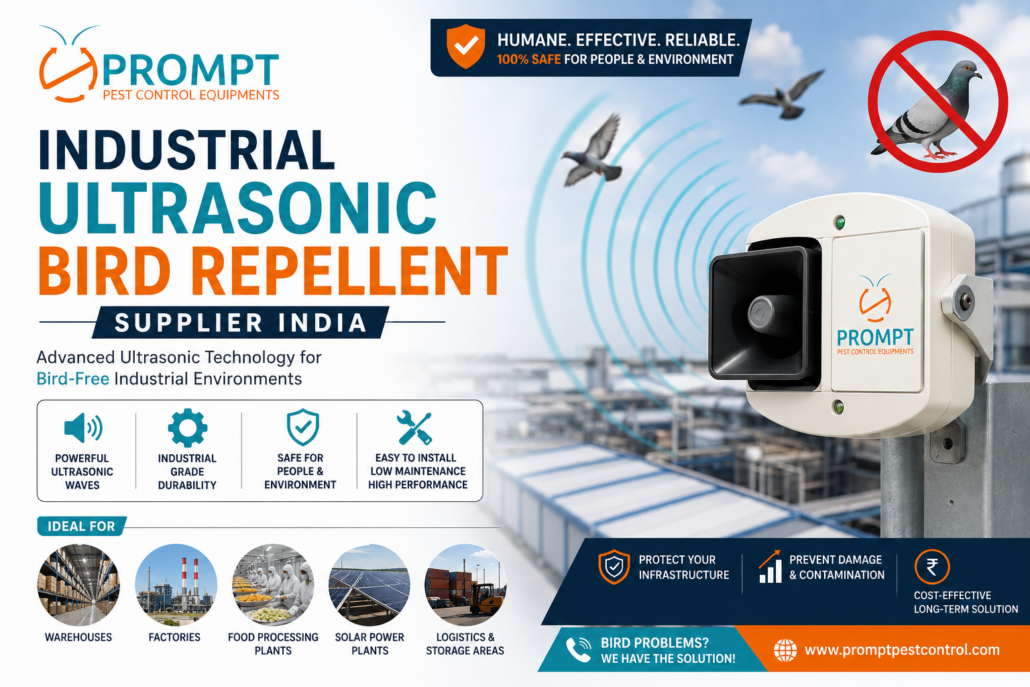
Industrial Ultrasonic Bird Repellent Supplier in India: The Complete Buyer’s Guide
Industrial Ultrasonic Bird Repellent Supplier India: Complete Buyer’s Guide
A single pigeon roosting inside a solar panel array can cost a plant thousands of rupees in cleaning and output loss every month. Droppings alone can reduce panel efficiency by a measurable margin within weeks. If you’re searching for an industrial ultrasonic bird repellent supplier in India, you’re likely already dealing with this kind of recurring cost: fouled machinery, contaminated raw material, blocked drainage, or compliance risk in a food grade facility. Industrial ultrasonic bird repellents are non toxic, sound based deterrent systems that emit high frequency sound waves to make bird prone zones uncomfortable for roosting and nesting without harming the birds, your equipment, or your staff.
This guide breaks down how these systems work, where they’re used, what separates a good supplier from a bad one, what to expect on pricing, and the mistakes that lead facilities to buy the wrong system.
What Is an Industrial Ultrasonic Bird Repellent? (How It Works)
An industrial ultrasonic bird repellent is a device that emits sound waves in the 20 kHz 65 kHz range largely above human hearing but well within the audible range for most pest bird species like pigeons, mynas, crows, and sparrows. The sound is emitted in varying, non repetitive patterns (static, predictable tones cause birds to habituate and ignore the sound within days). Industrial grade units cycle frequency and pulse intervals randomly, which prevents birds from adapting to the deterrent over time.
Frequency Range & Species Sensitivity
Different bird species respond to different frequency bands. Pigeons generally respond best to lower ultrasonic bands closer to 20 25 kHz, while smaller birds like sparrows and mynas respond to a broader spread up to 40 65 kHz. A well specified industrial system uses a multi frequency sweep rather than a single fixed tone, because a facility rarely has only one species to manage.
Coverage Area & Placement Logic
A single industrial ultrasonic unit typically covers 2,500 3,600 sq. ft. in open, unobstructed spaces. Coverage drops significantly around physical obstructions like rafters, ducting, and stacked inventory, since ultrasonic sound doesn’t travel around corners well. This is why placement matters more than device count: a supplier who does a proper site walk through and maps line of sight zones will spec fewer units more effectively than one who simply sells by square footage on paper.
Where Industrial Ultrasonic Systems Are Used
Warehouses & Cold Storage
High rafters, open dock doors, and stored grain or packaging material create ideal roosting conditions. Ultrasonic units are typically mounted at rafter height, angled downward across the open floor span.
Solar Power Plants
Birds roost under panel arrays and on mounting structures, and droppings on panel glass cause measurable output loss along with abrasive wear during cleaning. Ultrasonic units here are usually paired with perimeter fencing panel edge placement rather than a single central unit.
Food Processing Units
Contamination risk from bird droppings near open processing lines is a direct food safety liability. Ultrasonic systems are used alongside physical exclusion (netting, strip curtains) at loading bays rather than as a standalone solution.
Airports & Large Industrial Sheds
Bird strikes near runways and large open industrial sheds require wide coverage, weatherproof outdoor rated units, often integrated with visual deterrents for redundancy.
Ultrasonic vs. Other Bird Control Methods
| Method | Best For | Coverage | Non-Toxic | Typical Limitation |
| Ultrasonic Repellent | Open indoor spaces, warehouses, solar sites | ~2,500–3,600 sq. ft./unit | Yes | Reduced effectiveness around obstructions |
| Laser Bird Deterrent | Large open outdoor areas, dusk/night activity | Up to several acres (line-of-sight) | Yes | Needs line-of-sight; less effective in daylight glare |
| Bird Netting | Permanent exclusion at rooftops, facades | Physical barrier, area-specific | Yes | Higher upfront install cost, structural mounting needed |
| Bird Spikes | Ledges, beams, signage | Linear coverage (per foot) | Yes | Not effective for open-floor roosting |
| Bird Gel | Ledges, small perch points | Point-specific | Yes | Needs reapplication, less suited to large industrial spans |
| Scare Cannons | Large outdoor perimeters (solar, agri) | Wide radius, sound-based | Yes | Noise-sensitive locations may restrict use |
Most industrial sites don’t rely on one method alone. Ultrasonic units are frequently combined with netting at high risk entry points and visual deterrents at open bays for layered coverage.
How to Evaluate an Industrial Ultrasonic Bird Repellent Supplier in India
Use this checklist before signing off on a vendor:
Do they conduct a site survey before quoting? A supplier quoting by square footage alone, without inspecting rafters, obstructions, and bird activity patterns, is likely to under or over spec the system.
Do they specify frequency range and sweep pattern? Ask for the exact kHz range and whether the unit uses randomized versus fixed patterns.
Is the unit rated for your environment? Outdoor solar site units need weatherproofing (IP rating) that indoor warehouse units may not require.
Do they offer PAN India installation and support? Multi location facilities (chains of warehouses, solar farms across states) need a supplier who can service every site, not just the one nearest their office.
Is there an AMC (annual maintenance contract) option? Ultrasonic transducers degrade over years of continuous use; ongoing calibration checks matter.
Can they combine methods? A supplier offering only ultrasonic units, with no netting, spikes, or laser options, may push ultrasonic even where it isn’t the right fit.
Are claims realistic? Be cautious of suppliers promising “100% bird free guaranteed”. Legitimate industrial deterrent systems reduce roosting and nesting activity significantly but work best as part of a layered strategy, not a single silver bullet.
Pricing Logic What Affects Cost
Industrial ultrasonic bird repellent pricing in India varies based on:
Facility size and layout complexity open span warehouses need fewer units than facilities with multiple obstructed zones.
Indoor vs. outdoor weatherproof rating outdoor solar site units typically cost more due to IP rated enclosures.
Number of frequency zones species targeted multi species coverage requires broader spectrum units.
Installation complexity rafter height mounting in tall warehouses adds labor cost versus ground level solar site installs.
AMC inclusion a maintenance contract adds a recurring cost but protects against silent performance degradation.
Rather than comparing suppliers on a flat per unit price, ask for a cost per square foot covered figure after a site survey. This is the only way to compare quotes apples to apples.
Common Myths About Ultrasonic Bird Repellents
Myth 1: “Ultrasonic devices don’t work.”
This usually comes from experience with residential grade, fixed frequency units placed without a site survey. Industrial grade, randomized frequency systems, correctly placed by line of sight, perform very differently from a single plug in unit bought online.
Myth 2: “One unit covers the whole warehouse.”
Ultrasonic sound doesn’t bend around obstructions. A facility with rafters, stacked pallets, or ducting needs multiple units mapped to sightlines, not one central unit assumed to cover the full floor area.
Myth 3: “Birds get used to it immediately, so it’s pointless.”
Habituation happens with static, repetitive tones not with properly randomized industrial units. This is why sweep pattern specification matters more than raw decibel output when evaluating a system.
Mini Case Study: Food Processing Facility, North Indian Industrial Belt
A mid sized food processing unit in an industrial cluster in North India was dealing with pigeon roosting inside overhead ducting near its packaging line a direct contamination risk flagged during an internal food safety audit. The facility had previously tried bird spikes on external ledges alone, which didn’t address the interior roosting problem.
After a site survey identified three obstructed roosting zones along the ducting span, a combination of rafter mounted ultrasonic units (randomized frequency sweep) and netting at the loading bay entry points was installed. Roosting activity inside the ducting reduced noticeably within 2–3 weeks, and the facility added the ultrasonic units to its existing pest control AMC for periodic performance checks.
Installation & AMC What to Expect
A standard industrial installation includes: site survey and mapping, unit placement at rafter ceiling height or panel edge mounting (for solar sites), power wiring setup, and a post installation activity check after 2–3 weeks. AMC plans typically cover periodic calibration, transducer inspection, and frequency pattern updates to prevent habituation over multi year use.
FAQs
What is the coverage area of an industrial ultrasonic bird repellent?
A single industrial unit typically covers 2,500 3,600 sq. ft. in open, unobstructed spaces. Coverage drops around rafters, ducting, and stacked inventory, so facilities with obstructed layouts need multiple units mapped by line of sight rather than by total floor area alone.
Are ultrasonic bird repellents safe for food processing units?
Yes. Ultrasonic systems are non toxic and don’t involve chemicals or physical contact with product, making them suitable for food grade environments. They’re typically paired with netting or strip curtains at entry points for full contamination control.
Do ultrasonic bird repellents work on all bird species?
Effectiveness varies by species and frequency range. Pigeons generally respond to lower ultrasonic bands, while sparrows and mynas respond across a broader range, so multi frequency sweep units perform better than single tone devices across mixed bird activity.
How is industrial ultrasonic bird repellent pricing determined?
Pricing depends on facility size, layout complexity, indoor vs. weatherproof outdoor rating, number of frequency zones needed, and whether an AMC is included. A cost per square foot covered figure after a site survey is the most reliable way to compare supplier quotes.
Can ultrasonic repellents be used alongside other bird control methods?
Yes, and for most industrial sites this is recommended. Ultrasonic units handle open floor deterrence, while netting, spikes, or gel address specific perch points and entry gaps. A layered approach performs better than relying on one method alone.
How often does an ultrasonic bird repellent system need maintenance?
Industrial units benefit from periodic calibration checks, typically under an AMC, since transducers can degrade with continuous multi year use and fixed patterns can lead to habituation without periodic frequency updates.
Key Takeaways
Industrial ultrasonic bird repellents use randomized 20–65 kHz sound sweeps to deter roosting without harming birds or equipment.
Coverage per unit is roughly 2,500 3,600 sq. ft. in open spaces. Obstructions significantly reduce effective range.
A proper site survey (not a square footage only quote) is the single biggest differentiator between a good and a bad supplier.
Ultrasonic works best combined with netting, spikes, or laser deterrents rather than as a standalone fix.
Pricing should be compared on a cost per square foot covered basis after site assessment, not flat per unit cost.
AMC backed installations protect against performance drop off from transducer wear and bird habituation over time.
Conclusion
Choosing the right industrial ultrasonic bird repellent supplier in India comes down to one thing above all: whether they design a system around your facility’s actual layout, or just sell you units by square footage. Prompt Pest Control Equipments specifies and installs customized, non toxic ultrasonic, laser, and physical bird deterrent systems for factories, warehouses, food processing units, and solar plants across India, backed by PAN India installation and AMC support.


Leave a Reply
Want to join the discussion?Feel free to contribute!