
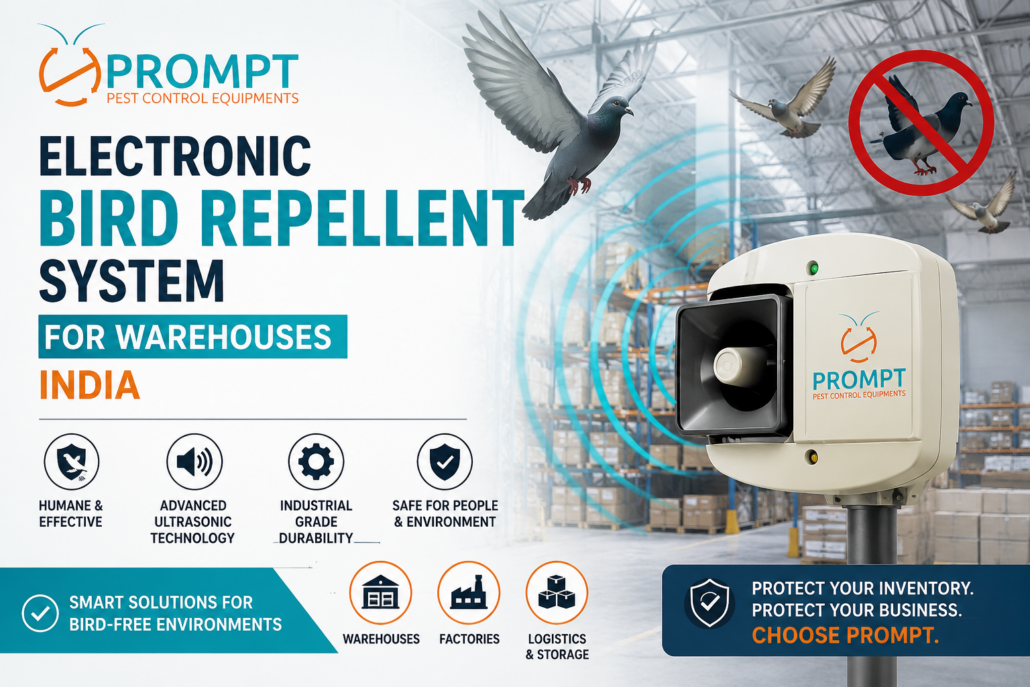
Electronic Bird Repellent System for Warehouses India: Complete Buyer’s Guide
Electronic Bird Repellent System for Warehouses India: Complete Buyer’s Guide
A single pigeon roosting in warehouse rafters can produce over 25 pounds of droppings a year and in food, pharma, or export grade storage facilities, that’s not a hygiene footnote, it’s a compliance risk. An electronic bird repellent system for warehouses in India is a technology based solution using ultrasonic sound, sonic bioacoustic distress calls, or laser deterrents designed to make large enclosed spaces uninhabitable for birds without trapping, poisoning, or physically harming them. This guide breaks down how these systems work, what actually separates an effective installation from a wasted one, and how to evaluate a supplier before you commit.
What Is an Electronic Bird Repellent System?
An electronic bird repellent system is a device or network of devices that uses electronically generated stimuli, sound frequencies, distress predator calls, or moving laser beams to disrupt a bird’s sense of safety in a given space, prompting it to leave and avoid returning. Unlike nets or spikes, which physically block access, electronic systems work behaviorally: they exploit birds’ natural aversion to specific sounds, frequencies, or unpredictable light movement. In warehouse settings, these systems are typically installed at roof truss height or along entry points (loading dock openings, ventilation gaps, skylights) and are programmed to run on timers or motion triggered cycles to prevent habituation.
Why Warehouses Attract Birds The Root Causes
Before any repellent system works, it helps to understand what’s drawing birds in:
High rafters and open trusses : Mimic natural cliff ledge nesting sites, especially for pigeons.
Consistent temperature : Warehouses stay warmer than outside air in winter, cooler in peak summer.
Open loading dock cycles : Repeated door opening creates easy, low risk entry windows.
Nearby food sources : Grain, packaged food, or waste storage facilities are magnets.
Minimal human foot traffic in upper zones : Birds sense reduced disturbance risk far above floor level activity.
This is why warehouses, cold storage units, and food processing facilities see disproportionately higher pigeon and sparrow activity compared to open plan offices; the structural profile itself invites nesting.
How Electronic Bird Repellent Systems Actually Work
Ultrasonic devices emit sound frequencies typically in the 20–30 kHz range above the threshold of human hearing but within the sensitive hearing range of most pest bird species. These devices work best in semi enclosed spaces where sound waves can be somewhat contained, since ultrasonic frequency degrades quickly over distance and is blocked by solid obstructions like stacked pallets or mezzanine flooring.
Sonic bioacoustic devices are often more effective for large open warehouse volumes. These play recorded predator calls (hawks, falcons) and species specific distress calls at randomized intervals, which prevents birds from acclimating the way they would to a constant tone. Coverage is typically rated by manufacturers in the 3,000–5,000 sq. ft. range per unit, though actual effective range depends on ceiling height and obstruction density.
Laser bird deterrents project a moving green or red beam across roof trusses and rafters. Birds perceive the moving beam as a physical threat approaching, triggering a flight response. Laser systems are most effective in low light or dawn dusk conditions (birds’ most active roosting return periods) and are commonly used where sound based methods aren’t practical due to worker noise sensitivity.
Most professionally specified warehouse installations combine two of these three technologies most commonly sonic + laser since each method compensates for the other’s blind spot (sound covers open volume, laser covers direct sightline roosting perches).
Comparison Table: Electronic vs. Physical vs. Chemical Bird Control Methods
| Method | How It Works | Best For | Limitations |
| Ultrasonic/Sonic Repellent | Emits distress/predator sound frequencies | Large open warehouses, loading docks | Sound blocked by obstructions; needs periodic call rotation |
| Laser Deterrent | Moving beam simulates approaching threat | High rafters, low light roosting periods | Less effective in bright daylight; line of sight dependent |
| Bird Netting | Physical barrier blocking access | Permanent exclusion from specific zones | High upfront install cost; requires structural mounting |
| Bird Spikes | Prevents landing on ledges/beams | Ledges, signage, small perch points | Not effective for large open roof volumes |
| Bird Gel | Sticky/UV reflective surface deters landing | Ledges, parapets | Needs reapplication; not suited to overhead trusses |
| Chemical Repellents | Taste/scent aversion | Limited industrial use in India | Regulatory restrictions; not humane-first approach |
For most warehouse environments, electronic systems and physical exclusion (netting spikes) are used together electronic devices deter birds from settling, while netting spikes block access to specific vulnerable ledges the electronic system doesn’t fully cover.
Choosing the Right Electronic Bird Repellent System Evaluation Checklist
Use this checklist before finalizing a vendor or system for your warehouse:
Coverage area match : Does the quoted device coverage (sq. ft.) match your actual warehouse volume, not just floor area?
Ceiling height compatibility : Sonic laser effectiveness varies significantly above 30–40 ft ceiling heights; ask for height specific specs.
Obstruction mapping : Has the supplier assessed pallet racking, mezzanine floors, and stored goods that could block sound laser lines?
Randomization anti habituation programming : Fixed tone or fixed pattern systems lose effectiveness within weeks; confirm randomized cycling.
Power and mounting requirements : Check voltage needs, cabling routes, and whether mounting requires structural modification.
AMC maintenance support : Does the supplier offer annual maintenance, frequency recalibration, and replacement parts PAN India?
Combination system option : Can the supplier integrate netting spikes at specific high risk ledges alongside the electronic system?
Non toxic, humane compliance : Confirm the system doesn’t rely on harmful chemical deterrents alongside the electronic components.
Myths & Misconceptions About Electronic Bird Repellents
Myth 1: “Ultrasonic devices don’t work they’re a gimmick.”
This usually stems from cases where a single small ultrasonic unit was used in a large open warehouse without accounting for range and obstruction loss. Ultrasonic devices underperform when oversold as a stand alone, one size fits all fix for large volumes; they work well in smaller, semi enclosed zones like dock offices or storage anterooms, not as the sole method across a 50,000 sq. ft. floor.
Myth 2: “Once installed, the system works forever with zero adjustment.”
Birds habituate to repeated, unchanging stimuli. Systems without randomized call rotation or periodic frequency adjustment typically see effectiveness drop within 6–8 weeks as birds learn the pattern poses no real threat.
Myth 3: “Electronic systems alone can fully bird proof a warehouse.”
Electronic repellents change behavior; they don’t physically block access. Facilities with severe existing nesting problems typically need netting or spikes at specific high risk ledges in combination with electronic deterrents for full spectrum control.
Mini Case Study: A Warehouse Facility’s Bird Problem, Method, Outcome
A packaged goods warehouse in an industrial belt near Ludhiana was dealing with persistent pigeon roosting along its overhead steel trusses, with droppings contaminating stacked inventory near the loading zone. The facility had previously tried a single fixed tone ultrasonic unit near the dock entrance, which showed no meaningful reduction in activity after a month.
The revised approach combined a sonic bioacoustic system with randomized predator call cycling covering the main floor volume, paired with a laser deterrent unit angled across the primary truss roosting line, and bird netting installed at two open ventilation gaps identified as entry points. Roosting activity showed a visible decline within 2–3 weeks of installation, with droppings accumulation in the loading zone reducing significantly by the end of the first month. The facility maintained the system on a periodic recalibration schedule to prevent habituation.
Installation & Coverage Planning Basics
Site survey first : Reputable suppliers assess ceiling height, obstruction layout, and existing entry points before quoting equipment, not after.
Zone based coverage : Large warehouses typically need multiple units positioned to cover overlapping zones rather than one central unit.
Entry point sealing : Ventilation gaps, broken skylight panels, and permanently open dock shutters should be addressed alongside electronic deterrents, since these remain physical access routes regardless of sound laser deterrents.
Testing period : A 2–3 week monitoring window after installation helps identify any coverage gaps needing a secondary unit or supplemental netting.
FAQs
Is an electronic bird repellent system effective for large warehouses?
Yes, when correctly specified for the space meaning multiple units positioned for overlapping coverage, ceiling height appropriate technology, and randomized programming. A single undersized unit in a large open volume typically underperforms and creates the false impression that the technology doesn’t work.
How much does an electronic bird repellent system cost for a warehouse in India?
Costs vary based on warehouse size, ceiling height, number of units required, and whether netting spikes are combined with the electronic system. Facilities should request a site survey based quote rather than relying on generic per unit pricing, since coverage needs vary significantly by structure.
Do electronic bird repellents harm birds?
No. Ultrasonic, sonic, and laser systems are designed to be non toxic and non lethal, working purely through behavioral deterrence rather than physical harm, making them a humane alternative to trapping or chemical methods.
How long does it take to see results after installation?
Most facilities see a noticeable reduction in roosting activity within 2–3 weeks, though full effectiveness depends on correct coverage mapping and addressing any physical entry points alongside the electronic system.
Can electronic systems be combined with netting or spikes?
Yes, and for facilities with existing nesting problems, this combination is typically recommended electronic deterrents change behavior across open volume, while netting spikes physically block access to specific high risk ledges the electronic system can’t fully cover.
Do these systems need ongoing maintenance?
Yes. Periodic recalibration, call frequency rotation, and physical inspection are needed to prevent bird habituation and to ensure devices remain correctly powered and positioned, especially in facilities with seasonal bird activity changes.
Key Takeaways
Electronic bird repellent systems use ultrasonic, sonic bioacoustic, or laser technology to deter birds behaviorally, without harm.
Warehouses attract birds due to high rafters, stable temperature, and low upper zone foot traffic.
Coverage area, ceiling height, and obstruction mapping determine real world effectiveness not just device specs on paper.
Combining electronic systems with netting spikes at high risk ledges typically delivers stronger full spectrum results than either method alone.
Habituation is the biggest cause of “systems that stop working” randomized programming and periodic recalibration prevent this.
A proper site survey before installation is the single biggest predictor of system effectiveness.
Conclusion
Electronic bird repellent systems offer Indian warehouses a humane, non toxic way to manage bird intrusion but effectiveness comes down to correct specification, not just installation. Coverage mapping, ceiling height, obstruction density, and anti habituation programming separate a system that works from one that gets abandoned after a few months.
Prompt Pest Control Equipments designs customized electronic bird repellent systems for warehouses, factories, food processing units, and solar plants across India, combining sonic, laser, and physical exclusion methods based on a proper site assessment rather than one size fits all equipment. To explore system options, or for more facility specific examples. Reach out for a site survey and customized quote.


Leave a Reply
Want to join the discussion?Feel free to contribute!