
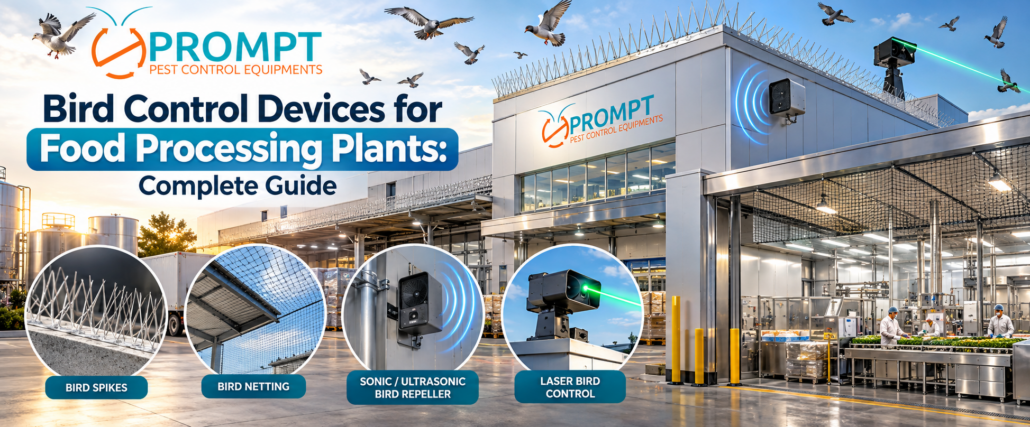
Bird Control Devices for Food Processing Plants: Complete Guide
A bird inside a food processing plant is more than a nuisance. It can create hygiene concerns, contaminate production areas, damage equipment, and complicate efforts to maintain a controlled manufacturing environment. The right Bird Control Devices for Food Processing Plants combine physical exclusion, deterrent technology, and site-specific placement to reduce bird activity without introducing toxic substances into the production environment.
For Indian food processing facilities, the most practical approach is usually a customized combination of bird spikes, bird netting, sonic or ultrasonic deterrents, visual deterrents, bird gels, and laser systems, depending on the building design and bird behavior.
Why Bird Control Is Different in Food Processing Plants
Food processing plants have open loading areas, ventilation structures, elevated ledges, warehouses, roof spaces, drainage systems, and equipment platforms that can attract birds. Birds may also be drawn to food odors, waste-handling areas, water sources, and sheltered nesting locations.
The challenge is that a solution suitable for an ordinary commercial building may not be appropriate around food production zones. Bird control must account for hygiene, access, maintenance, employee safety, equipment compatibility, and the movement of raw materials and finished products.
Common problem areas include:
- Production halls
- Raw-material receiving areas
- Loading and unloading bays
- Warehouse roofs
- Cold-storage entrances
- Packaging areas
- Waste collection zones
- HVAC and ventilation structures
- Roof-mounted equipment
- Structural beams and ledges
- Parking and dispatch areas
- Open-sided storage areas
A good bird management plan therefore starts with where birds land, why they are landing there, and whether they are nesting or simply using the area as a temporary roost.
What Are Bird Control Devices for Food Processing Plants?
Bird Control Devices for Food Processing Plants are non-toxic physical, visual, acoustic, or behavioral deterrent systems designed to prevent birds from entering, landing, roosting, or nesting around industrial food facilities. Common technologies include bird netting, spikes, bird gels, sonic and ultrasonic devices, lasers, visual scare devices, and other site-specific deterrents.
These devices do not all perform the same function. Physical exclusion prevents access to a defined area, while active deterrents attempt to make a location uncomfortable or unsuitable for birds.
The correct technology depends on the bird species, pressure level, building architecture, target area, and whether the objective is exclusion, deterrence, or both.
What Attracts Birds to Food Processing Facilities?
Birds generally establish activity where they can find food, water, shelter, nesting opportunities, or safe elevated resting locations.
Food processing facilities can unintentionally provide several of these conditions.
Food and waste
Poorly contained waste, spilled raw materials, discarded packaging, and exposed food residues can attract pigeons, mynas, crows, sparrows, and other birds.
Waste management should therefore be treated as part of bird control rather than as a completely separate issue.
Protected nesting locations
Roof voids, ducts, beams, machinery platforms, ventilation structures, and gaps beneath roofing can provide sheltered nesting locations.
Once birds establish a nesting site, simple visual deterrents may not be enough.
Elevated surfaces
Birds naturally use high surfaces for observation and resting. Roof edges, pipes, beams, signage, equipment housings, and structural ledges can become regular roosting points.
Water
Standing water around drains, cooling equipment, roof areas, or external washing zones can contribute to bird activity.
Which Bird Control Devices Work Best in Food Processing Plants?
There is no universal device that works equally well across every food processing facility. Physical exclusion is generally used where permanent access prevention is practical, while active deterrents are more useful for open areas, large roofs, yards, and locations where netting or spikes are unsuitable.
| Bird control method | Primary function | Suitable areas | Key consideration |
| Bird netting | Physical exclusion | Open structures, loading areas, roof voids | Requires correct anchoring and tension |
| Bird spikes | Prevent landing | Ledges, beams, signs, parapets | Best for defined landing surfaces |
| Bird gel | Discourage landing | Ledges and architectural surfaces | Requires correct application and maintenance |
| Sonic deterrents | Behavioral deterrence | Large indoor/outdoor areas | Requires species-appropriate programming |
| Ultrasonic systems | Acoustic deterrence | Selected enclosed/semi-enclosed areas | Performance depends heavily on placement and target species |
| Laser bird deterrents | Visual deterrence | Large open areas and roofs | Requires suitable operating conditions |
| Visual scare devices | Visual deterrence | Open areas | Birds may habituate if used alone |
| Bird scare cannons | Acoustic disturbance | Large agricultural/open environments | Generally unsuitable near occupied industrial areas without careful assessment |
The objective should not be to install the largest number of devices. It should be to create a layered bird management system where each device addresses a specific behavior or access route.
Bird Netting for Food Processing Plants
Bird netting is one of the most direct ways to prevent birds from entering a defined area. It creates a physical barrier between the bird and the protected space.
Netting is particularly useful for:
- Loading docks
- Warehousing structures
- Open-sided buildings
- Atriums
- Roof voids
- Courtyards
- Covered production areas
- Ventilation structures
- Large internal spaces
How Bird Netting Works
Bird netting physically closes the route through which birds enter an area. When properly designed, the mesh prevents birds from passing through while allowing normal movement of air and light.
The mesh size should be selected according to the bird species being excluded. Installation also requires attention to corners, support points, gaps, doors, service penetrations, and other possible entry routes.
A poorly installed net can leave small openings that birds quickly discover.
Advantages of bird netting
- Physical exclusion
- Long-term application when properly installed
- No chemical exposure
- Suitable for large openings
- Can protect defined zones continuously
Limitations
- Requires professional installation
- Needs structural anchoring
- Can interfere with maintenance access if poorly designed
- Not suitable for every architectural surface
Bird Spikes for Industrial Food Facilities
Bird spikes are designed to make narrow landing surfaces uncomfortable or impractical for birds.
They are commonly considered for:
- Parapets
- Beams
- Pipework
- Ledges
- Sign structures
- Roof edges
- Equipment housings
Bird spikes do not usually prevent a bird from flying into an entire building. Instead, they address a specific landing or roosting surface.
For that reason, spikes work best when a site survey identifies the exact surfaces birds are repeatedly using.
Bird Gels: How Do They Work?
Bird gels create an unpleasant landing surface through a combination of tactile and visual deterrent effects. Depending on the product formulation, birds may perceive the treated surface as unsuitable for landing.
They can be considered for selected ledges and architectural surfaces where spikes are difficult to install.
However, food processing facilities require careful product selection and placement. The application should prevent direct contact with food, packaging, processing equipment, and areas where residue could create a hygiene or maintenance problem.
Sonic and Ultrasonic Bird Deterrents
Sonic and ultrasonic bird control systems use sound-based deterrence rather than physically blocking access.
Sonic systems typically produce audible sound patterns intended to influence bird behavior, while ultrasonic systems operate at frequencies above the commonly audible range for humans. Their effectiveness depends on the target species, environment, device specification, placement, and whether birds have become accustomed to the sound.
This distinction matters because the term “ultrasonic bird repeller” is often used broadly in the market.
A device should not be selected simply because its specification mentions an ultrasonic frequency.
Why Sound-Based Systems Sometimes Underperform
Birds may continue using a location if:
- The device does not target the relevant species effectively.
- The coverage is incorrectly calculated.
- Buildings or machinery block the signal.
- Birds have already established nesting behavior.
- The device is installed too far from the problem area.
- The sound pattern is predictable.
- Physical food and water attractants remain available.
Sound-based deterrents are therefore best treated as part of an integrated control strategy rather than as an automatic solution.
Laser Bird Deterrents for Large Industrial Areas
Laser bird deterrents use moving or controlled light patterns to create a visual stimulus that birds perceive as a potential threat or environmental disturbance.
They can be considered for:
- Large roofs
- Open yards
- Solar installations
- Warehousing compounds
- Agricultural processing areas
- Large external structures
Their usefulness depends on environmental conditions, installation geometry, operating schedules, and the target bird species.
A laser system should be professionally specified and operated according to applicable safety requirements. It should never be directed toward people, vehicle operators, aircraft, or other areas where the beam could create a hazard.
Visual Bird Scare Devices
Visual deterrents use objects or movement to discourage birds from occupying a location.
Examples can include:
- Reflective deterrents
- Predator-style visual devices
- Moving objects
- Bird scare installations
They can be useful in combination with other technologies, particularly where bird pressure is moderate.
The major limitation is habituation.
Birds can learn that a stationary object does not represent a real threat. Rotating or combining deterrents can help reduce predictability, but visual systems should still be selected based on the actual site conditions.
Why One Bird Control Device Is Rarely Enough
Imagine a food processing plant with pigeons entering through an open loading structure.
Installing spikes on one ledge may prevent birds from resting there. But if the birds can still enter through the loading area, they may simply move to another beam.
A more complete approach could involve:
- Closing unnecessary access points.
- Installing netting where permanent exclusion is possible.
- Treating major landing ledges with physical deterrents.
- Using active deterrents in open areas.
- Removing food and water attractants.
- Monitoring bird activity after installation.
- Adjusting the system based on observed behavior.
This is why customized bird control system design is more useful than choosing equipment based only on a product category.
How to Design Bird Control for a Food Processing Plant
A practical site assessment should follow a defined process.
Step 1: Map bird activity
Identify:
- Entry points
- Nesting areas
- Roosting surfaces
- Feeding locations
- Water sources
- Flight paths
- High-pressure zones
Step 2: Classify the behavior
Determine whether the problem is primarily:
- Entry
- Roosting
- Nesting
- Feeding
- Perching
- Loitering
Different behavior requires different control measures.
Step 3: Divide the facility into zones
For example:
Zone A: Food production
Zone B: Packaging
Zone C: Warehouse
Zone D: Loading bay
Zone E: External yard
Zone F: Roof
Each zone may require a different combination of controls.
Step 4: Select the control technology
Use physical exclusion where access can be permanently blocked.
Use landing deterrents on defined surfaces.
Use active systems where the area is large, open, or unsuitable for physical exclusion.
Step 5: Check maintenance requirements
A system should remain practical after installation. Consider:
- Cleaning access
- Equipment servicing
- Net inspection
- Device power requirements
- Replacement intervals
- Roof access
- Future building modifications
Step 6: Monitor and adjust
Bird behavior can change after installation.
A professional system should therefore be evaluated after deployment rather than assumed to be permanently effective from day one.
Bird Control and Food Safety Considerations
Bird activity around food facilities can create hygiene and contamination concerns because birds may carry microorganisms, nesting material, feathers, and droppings into areas where they should not be present.
The exact food-safety requirements depend on the facility, product, process, jurisdiction, and applicable regulatory framework.
For Indian operations, bird management should be incorporated into the site’s broader sanitation, pest-management, cleaning, waste-control, and preventive-maintenance procedures.
It is also important to distinguish bird control equipment from chemical pest-control treatments. Physical and non-toxic deterrent methods can be useful where minimizing chemical exposure around sensitive production environments is a priority.
How to Choose Bird Control Devices for Food Processing Plants
Before purchasing equipment, evaluate the following factors.
1. Bird species
Pigeons, sparrows, crows, mynas, and other birds can behave differently.
2. Problem location
A 20-metre ledge and a large open warehouse require different approaches.
3. Bird pressure
Occasional landing is different from an established nesting colony.
4. Building structure
Consider:
- Roof height
- Beam arrangement
- Ventilation
- Openings
- Machinery
- Access doors
- Lighting
- Electrical availability
5. Hygiene requirements
The device should not create a new contamination or cleaning problem.
6. Maintenance
Ask how the system will be inspected and maintained after installation.
7. Coverage
Do not rely solely on a manufacturer’s generic coverage statement. Actual coverage can change because of walls, machinery, structural obstructions, mounting height, and environmental conditions.
8. Integration
The most effective system may combine several technologies.
9. Installation quality
Even a technically suitable device can perform poorly if incorrectly positioned.
10. After-sales support
For a large industrial facility, installation support and future servicing can be as important as the equipment itself.
Common Mistakes When Installing Bird Control Equipment
Choosing equipment before conducting a site survey
The same device can perform differently in two buildings because the architecture and bird behavior are different.
Treating coverage numbers as guaranteed results
A manufacturer’s stated coverage area is not necessarily the same as effective real-world coverage.
Walls, machinery, roof geometry, bird species, installation height, and environmental conditions can change performance.
Using only one deterrent
Birds can adapt when a single deterrent remains predictable.
Ignoring nesting sites
Removing a landing point does not necessarily solve an established nesting problem.
Leaving attractants untouched
If exposed food waste remains available, deterrent equipment has to compete with a strong natural attractant.
Myths and Misconceptions About Industrial Bird Control
Myth 1: One ultrasonic device can solve an entire factory
Not necessarily. Effective coverage depends on the equipment, environment, target species, mounting position, obstructions, and bird behavior. Large industrial facilities may require multiple zones and complementary physical exclusion measures.
Myth 2: Bird spikes solve every pigeon problem
Spikes primarily address landing surfaces. They do not physically seal open buildings, prevent birds from entering through large openings, or automatically eliminate nesting elsewhere.
Myth 3: Visual deterrents work permanently without maintenance
Birds can habituate to predictable visual stimuli. Changing the deterrent strategy and combining methods can reduce the likelihood of adaptation.
Myth 4: The most expensive system is automatically the most effective
Cost does not replace correct system design. A lower-cost physical barrier may be more appropriate for one opening, while a large open roof may require an active deterrent system.
Mini Case Example: Food Processing Facility in Gujarat
Consider a food processing facility in an industrial area of Gujarat where pigeons repeatedly entered an elevated loading and storage structure.
The main problem was not simply bird presence. Birds were using overhead beams and sheltered roof sections for roosting, while open access points allowed them to return after cleaning.
A practical control plan would begin by mapping the entry routes and identifying the highest-use roosting surfaces. Physical exclusion could then be used at suitable openings, while landing deterrents could address defined structural surfaces. An active deterrent could be considered for larger open areas where physical exclusion was impractical.
After installation, bird activity should be monitored rather than judged solely on the first few days. Typical bird-management programs may require adjustments over the following weeks as birds change their movement patterns.
This example illustrates an important principle: the equipment should follow the bird behavior, not the other way around.
Why Customized Bird Control Matters for Industrial Facilities
Food processing plants are rarely uniform buildings.
One facility may have a closed production hall and open loading dock. Another may have extensive rooftop equipment, ventilation structures, and semi-open warehouses.
A suitable system therefore considers:
Bird species → behavior → entry route → landing surface → building architecture → hygiene requirements → control technology → maintenance
This sequence is more reliable than simply selecting a device because it is advertised as covering a particular square-foot area.
Why Choose Prompt Pest Control Equipment?
Prompt Pest Control Equipments provides industrial and commercial bird control equipment for facilities that need a structured approach to bird exclusion and deterrence.
The product categories can include:
- Sonic bird repellers
- Ultrasonic bird deterrents
- Laser bird deterrents
- Visual bird scare devices
- Bird gels
- Bird spikes
- Bird netting
- Bird scare systems
For large facilities, the emphasis should be on technical system selection rather than one-size-fits-all equipment.
Prompt Pest Control Equipments can be considered for bird-control requirements across industrial environments in India, including food processing plants, factories, warehouses, solar facilities, and other large commercial properties.
The appropriate equipment should be selected after understanding the site’s bird activity, building layout, target areas, and operational requirements.
Key Takeaways
- Bird control in food processing plants requires more than simply installing a repeller.
- Start with a site survey and bird-behavior assessment.
- Use netting and other physical barriers where permanent exclusion is practical.
- Use spikes and gels for specific landing and roosting surfaces.
- Consider sonic, ultrasonic, laser, and visual deterrents for appropriate open or difficult-to-protect areas.
- Do not rely on generic coverage claims; building geometry and installation quality matter.
- Include waste, food, and water management in the overall bird-control strategy.
- Choose an industrial supplier that can help with system specification, installation, and ongoing support.
Conclusion: Build a Bird Control System Around the Facility
The right Bird Control Devices for Food Processing Plants are determined by the facility’s actual bird problem. A loading dock, production hall, warehouse roof, ventilation structure, and external yard can require completely different control approaches.
Instead of selecting equipment based only on price or advertised coverage, assess the bird species, entry points, roosting surfaces, nesting behavior, building structure, hygiene requirements, and maintenance needs.
Prompt Pest Control Equipments supplies a range of industrial bird-control technologies for commercial and industrial applications across India. If birds are entering, nesting, or repeatedly roosting around your food processing facility, request a site-specific assessment and discuss a customized combination of physical and active deterrents.
Contact Prompt Pest Control Equipment to discuss your facility layout, bird problem, target areas, and suitable industrial bird-control options.
Frequently Asked Questions
What are the best Bird Control Devices for Food Processing Plants?
The appropriate device depends on the bird species, building design, and problem location. Bird netting and spikes provide physical exclusion or landing prevention, while sonic, ultrasonic, laser, visual, and gel systems can address other situations. Many industrial facilities benefit from combining physical and active deterrents rather than relying on one device.
Are ultrasonic bird repellers suitable for food processing facilities?
Ultrasonic systems can be considered for selected industrial environments, but suitability depends on the target species, building structure, installation position, and equipment specification. They should not be selected solely because they advertise a large coverage area. A site assessment helps determine whether ultrasonic deterrence is appropriate for the particular problem.
Can bird netting be used inside a food processing plant?
Yes, bird netting can be used in suitable internal or semi-enclosed areas to physically prevent birds from entering protected spaces. The design should account for hygiene, cleaning, maintenance access, fire-safety requirements, equipment movement, and structural anchoring. Mesh selection should also correspond to the bird species being excluded.
How do I choose bird control equipment for a factory?
Start by identifying bird species, entry routes, nesting locations, roosting surfaces, and attractants. Then divide the facility into control zones and select physical or active deterrents for each zone. Consider installation, coverage, maintenance, hygiene, durability, power requirements, and after-sales support before purchasing equipment.
Do bird spikes permanently solve pigeon problems?
Bird spikes can provide long-term landing prevention when correctly installed on appropriate surfaces, but they do not solve every pigeon problem. Birds may continue using other ledges, roofs, beams, or access points. For established infestations, spikes may need to be combined with exclusion, sanitation improvements, and other deterrent methods.
How long does an industrial bird control system take to work?
The timeframe varies according to bird species, population, nesting behavior, attractants, and the selected control system. Physical exclusion can prevent access as soon as installation is complete, while behavioral deterrents may require a period of adjustment and monitoring. A system should be evaluated over several weeks and modified where necessary.


Leave a Reply
Want to join the discussion?Feel free to contribute!