
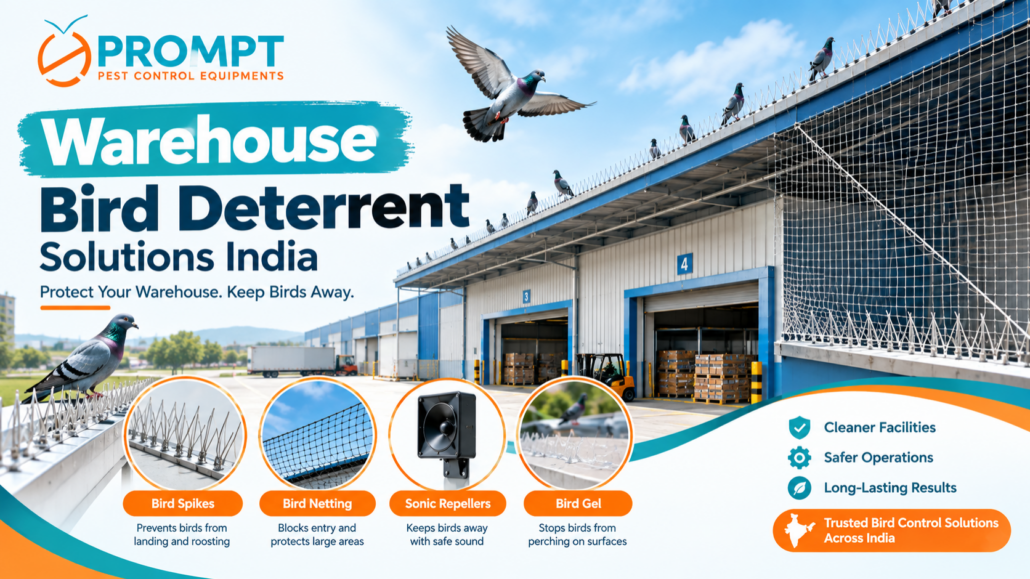
Warehouse Bird Deterrent Solutions India Guide
Warehouse Bird Deterrent Solutions India Guide
A single pigeon can produce close to 12 kilograms of droppings a year, and in a warehouse full of stacked inventory, overhead conveyors, and exposed wiring, that is enough to shut down a shift. Warehouse Bird Deterrent Solutions India typically combines a physical barrier, such as netting or spikes, with an active repellent, such as a sonic or laser system, matched to the height, layout, and product stored in that specific facility. There is no single fix that works for every warehouse. The right combination depends on roof height, whether the space is open sided, and what is stored inside.
What Is a Warehouse Bird Deterrent Solutions India
A Warehouse Bird Deterrent Solutions India is a combination of equipment installed to stop birds, most commonly pigeons and sparrows, from roosting, nesting, and feeding inside or on industrial storage structures. It generally includes a physical exclusion layer, such as netting across open bays or spikes along ledges, paired with an active deterrent, such as ultrasonic sound or laser movement, that keeps birds from settling in the first place. The goal is not to kill or trap birds. It is to make the warehouse environment unappealing enough that birds relocate on their own within a few weeks of installation.
Why Warehouses in India Attract Birds
Indian warehouses are often more bird friendly than the people running them realize. Understanding why birds show up in the first place is the first step to choosing the right deterrent.
Open Loading Docks and Roof Gaps
Most Indian warehouses are built with large roll up shutters, open loading bays, and metal roof sheets with expansion gaps. These openings give pigeons and sparrows an easy entry point and a dry, predator free space to nest above stacked pallets. Metal roof trusses in particular offer ledges that mimic natural cliff faces, which is exactly the kind of surface pigeons prefer for roosting.
Grain, Feed, and Food Processing Storage
Warehouses that store grain, animal feed, packaged food, or agricultural produce attract birds looking for an easy meal. Spilled grain near loading areas or gaps in packaging seals act as a constant food source, which keeps a bird population returning even after a partial cleanup.
Warm Ventilation and Overhead Truss Structures
Ventilation outlets, HVAC ducting, and overhead cable trays generate warmth, especially in facilities running machinery around the clock. Birds are drawn to these warm zones during cooler months, and once a few birds settle, droppings and nesting material accumulate quickly in areas that are hard to inspect and clean.
The Real Cost of Ignoring a Bird Problem in Your Warehouse
Bird activity inside a warehouse is not just a cleanliness issue. Droppings are acidic and corrode metal roofing, structural steel, and electrical junction boxes over time, which shortens the working life of the building itself. In food storage and processing facilities, bird droppings and feathers create a direct contamination risk that can affect FSSAI compliance during inspection. Nesting material collected near electrical panels and rooftop units is also a recognized fire risk in industrial settings, since dry twigs and feathers are highly flammable. General industry findings on bird related damage consistently point to structural corrosion, contamination, and fire hazard as the three most expensive consequences of an unmanaged infestation, well beyond the visible mess on the warehouse floor.
Types of Warehouse Bird Deterrent Solutions India
There is no universal Warehouse Bird Deterrent Solutions India. Each method below works on a different principle, and most warehouses need two or three of them working together.
Sonic and Ultrasonic Bird Repellers
Sonic repellers emit distress calls and predator sounds at randomized intervals, typically cycling through several bird species specific alarm calls so birds do not become used to a repeating pattern. Ultrasonic repellers emit sound in the 20 to 25 kilohertz range, above human hearing but within range for some bird species, though their effectiveness varies more than sonic systems because bird hearing sensitivity differs by species and by distance from the source. Sonic systems generally cover an open warehouse bay up to about 1,500 square meters per unit, depending on ceiling height and how much the sound reflects off metal roofing.
Laser Bird Deterrent Systems
Laser bird deterrents project a moving green or red beam across roof trusses, rafters, and open storage areas. Birds perceive the moving beam as a physical threat approaching them, which triggers a flight response without the bird ever needing to be trained or conditioned to recognize it as danger. These systems work best in low light conditions, such as dusk, dawn, and dimly lit warehouse interiors, and are commonly used in facilities where noise based deterrents are impractical because of ongoing staff activity on the floor.
Pigeon Netting for Warehouses
Netting is a full exclusion barrier, typically made of UV resistant polyethylene, installed across open loading bays, skylights, and roof void areas to physically block bird entry. Unlike sound or light based systems, netting does not rely on the bird choosing to leave. It simply removes access to the space. Mesh size is chosen based on the target bird, generally 19 millimeters for sparrows and 50 millimeters for pigeons, and a properly tensioned installation can remain effective for well over a decade with minimal upkeep.
Bird Spikes for Warehouse Roofs and Ledges
Spikes are narrow strips of blunt tipped plastic or stainless steel points fixed along ledges, roof edges, signage, and pipe runs. They do not injure birds. They simply remove the flat landing surface a bird needs to perch, which forces the bird to find another ledge elsewhere. Spikes are most useful on narrow linear surfaces where netting would be impractical, such as parapet edges, cable trays, and beam flanges.
Bird Repellent Gel
Bird gel works on a surface tension and sensory irritation principle. Applied in small dots along ledges and beams, the gel creates a sticky, uneven surface that birds find uncomfortable to land on, combined in most formulations with a UV reflective compound that appears as fire to a bird’s wider visual spectrum, even though it is invisible or barely noticeable to the human eye. Gel needs reapplication every 6 to 12 months depending on dust accumulation and temperature, since heat and airborne dust reduce its tackiness over time.
Visual Scare Devices
Reflective scare tape, predator eye balloons, and moving decoy predators work on the principle of unpredictable visual disruption. Birds are wary of shapes and movement that resemble a predator or an unfamiliar threat, though this method is the least durable on its own because birds tend to habituate to a static visual cue within a few weeks. It is best used as a supporting layer alongside netting or a sonic system, not as the sole solution.
Bird Scare Cannons
Propane powered scare cannons produce a loud, randomized bang audible over long distances, historically used in open agricultural land and now applied to large open sided industrial yards and warehouse loading areas where noise regulations permit it. Because of the noise output, cannons are generally limited to facilities in industrial zones away from residential areas and are not suitable for enclosed or urban warehouse settings.
Comparing Warehouse Bird Deterrent Solutions India Methods
| Method | Best Suited For | Typical Coverage | Durability | Humane |
| Sonic and ultrasonic repeller | Large open bays, loading docks | Up to 1,500 sq m per unit | 2 to 3 years before recalibration | Yes |
| Laser deterrent | Low light interiors, rafters, roof trusses | Up to 5,000 sq m depending on beam range | 3 to 5 years | Yes |
| Pigeon netting | Open sided bays, skylights, roof voids | Full physical exclusion, any size | 10 plus years | Yes |
| Bird spikes | Ledges, beams, parapets, signage | Linear surfaces, any length | 10 plus years | Yes |
| Bird gel | Beams, ledges, small perch points | Localized, per meter | 6 to 12 months per application | Yes |
| Visual scare devices | Supplementary use only | Localized | 2 to 6 weeks before habituation | Yes |
| Scare cannons | Large open industrial yards | Several hundred meters radius | Ongoing, weather dependent | Yes |
How to Evaluate a Warehouse Bird Control Supplier
A poorly specified system fails within months, so the supplier selection matters as much as the equipment itself.
- Ask for a site survey before any quote. A supplier that prices a system without inspecting roof height, bay openings, and stored material is guessing.
- Confirm the mesh size and material grade for any netting quoted, since UV resistance and mesh size directly affect how long the installation lasts.
- Check whether the sonic or laser equipment is rated for continuous industrial use, not a residential or garden grade unit relabeled for commercial sale.
- Ask what an Annual Maintenance Contract includes, specifically whether it covers gel reapplication, netting inspection, and equipment recalibration.
- Confirm PAN India delivery and installation support if you operate more than one facility, so the same supplier can service every location under one contract.
- Request a realistic timeline for results. Any supplier promising an overnight fix for an established roosting population is overstating what any method can do.
Myths and Misconceptions About Warehouse Bird Control
Myth: Ultrasonic devices do not work at all. Ultrasonic repellers underperform when installed in open outdoor areas where sound disperses quickly, or when placed too far from the actual roosting site. In an enclosed warehouse bay where sound reflects off metal roofing and walls, properly placed ultrasonic units are considerably more effective, which is why placement and enclosure type matter more than the technology itself.
Myth: Netting is only useful for open air balconies and buildings, not industrial spaces. Netting is actually one of the most reliable options for warehouses precisely because it physically excludes birds rather than relying on a behavioral response, and it performs well across large open bays, skylights, and mezzanine gaps that other methods cannot fully cover.
Myth: One installation solves the problem permanently. Bird deterrent systems reduce and prevent activity, but ongoing maintenance, such as gel reapplication and periodic equipment checks, is what keeps a warehouse bird free over years rather than months. Treating installation as a one time task rather than an ongoing program is the most common reason a system appears to stop working.
Case Study A Food Storage Warehouse in an Indian Industrial Belt
A food processing storage facility in an industrial belt in Punjab had been dealing with pigeon roosting in its overhead ducting and roof trusses for close to two years. Cleaning crews were clearing droppings from stacked packaging on a weekly basis, and an internal food safety audit flagged the contamination risk as a compliance concern. The facility installed pigeon netting across the open loading bay combined with bird spikes along the exposed cable trays and a sonic repeller unit near the main roosting zone. Roosting activity dropped noticeably within 2 to 3 weeks of installation, and by the following quarterly audit, the facility reported no droppings related findings in the storage zone. The combination of physical exclusion and an active deterrent addressed both the entry points and the birds already established inside.
Installation Process and Annual Maintenance Contracts
A typical Warehouse Bird Deterrent Solutions India installation begins with a site survey to map roof height, bay openings, roosting hotspots, and stored material. From there, the supplier proposes a combination of methods rather than a single product, since most warehouses need netting or spikes at entry points paired with an active deterrent at the interior roosting zone. Installation for a mid sized warehouse generally takes 2 to 4 days depending on roof access and the extent of netting required. An industrial bird control AMC, or annual maintenance contract, is strongly recommended over a one time purchase, since it covers periodic inspection, gel reapplication, netting repair, and recalibration of sonic or laser units, which is what keeps the system effective across seasons and changing bird pressure.
What Drives Bird Proofing Cost in India
Bird proofing cost in India varies widely because it depends on warehouse size, roof height, the number of open entry points, and which combination of methods the facility needs. A small warehouse needing only spikes on a few ledges costs far less than a large open bay facility requiring full netting across multiple skylights plus a sonic or laser system. Facilities that store food or grain often need a more thorough exclusion setup because the contamination risk is higher, which raises the overall system cost compared with a general storage warehouse holding non food inventory. The most accurate way to budget is a site specific quote following a physical survey, since national average figures rarely reflect what a specific roof structure and layout actually requires.
Frequently Asked Questions
What is the best bird deterrent for a warehouse in India?
There is no single best option, since the right system depends on warehouse layout. Most effective setups combine a physical barrier, such as netting or spikes at entry points, with an active deterrent, such as a sonic or laser unit, at the interior roosting zone.
How long does it take to see results after installation?
Most facilities see a noticeable drop in roosting activity within 2 to 3 weeks of installation, though full relocation of an established bird population can take slightly longer depending on how long birds have been nesting in the space.
Are ultrasonic bird repellers safe for warehouse workers?
Yes. Ultrasonic frequencies are set above the range of human hearing, so they do not disrupt staff working in the facility, and they are not harmful to humans or other animals present on site.
Do I need netting and a sonic system, or just one of the two?
Most warehouses benefit from both. Netting blocks new birds from entering, while a sonic or laser system addresses birds already roosting inside before the exclusion barrier goes up.
How often does a warehouse bird control system need maintenance?
Netting and spikes need periodic inspection, roughly every 6 months, while gel needs reapplication every 6 to 12 months and sonic or laser units need occasional recalibration, which is typically bundled into an annual maintenance contract.
Is warehouse bird proofing available across all of India, or only major cities?
PAN India suppliers deliver and install industrial bird control systems across major cities and industrial belts, including facilities outside metro areas, provided the supplier maintains a national logistics and installation network.
Key Takeaways
- Warehouse bird problems in India are usually driven by open loading docks, roof gaps, and stored grain or food.
- Ignoring bird activity leads to structural corrosion, contamination risk, and fire hazard, not just a cleaning issue.
- Netting and spikes physically exclude birds, while sonic and laser systems actively deter birds already inside.
- Most effective warehouse installations combine two or more methods rather than relying on a single product.
- An annual maintenance contract, not a one time purchase, is what keeps a system effective long term.
- Bird proofing cost depends on warehouse size, roof height, and stored material, and is best confirmed through a site survey.
Conclusion
Warehouse Bird Deterrent Solutions India works best when they are matched to the specific structure they are protecting, not chosen off a generic product list. A facility with open loading docks and food storage needs a very different setup from a fully enclosed warehouse with high roof trusses, and the suppliers who get results are the ones who survey the site before recommending equipment. Prompt Pest Control Equipments designs bird deterrent systems for factories, warehouses, food processing units, solar plants, and airports across India, using humane, nontoxic methods customized to each facility rather than a one size fits all package. If bird activity is already visible in your warehouse, a site survey is the fastest way to find out exactly which combination of methods your space needs.


Leave a Reply
Want to join the discussion?Feel free to contribute!