
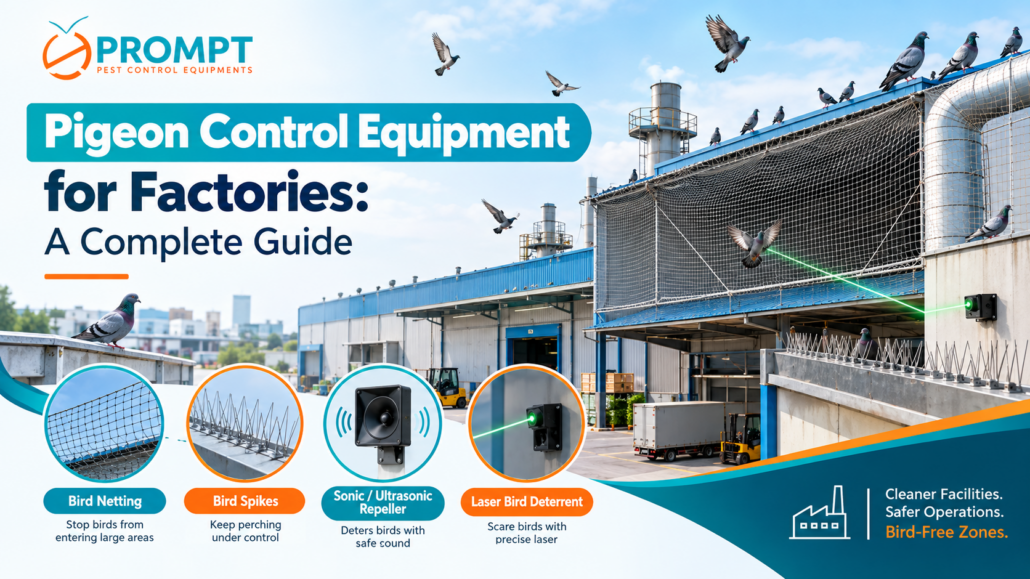
Pigeon Control Equipment for Factories: A Complete Guide
A single pair of pigeons can leave behind more than ten kilograms of droppings on a factory roof in one year, and that waste carries bacteria, fungal spores, and acid strong enough to corrode metal sheeting, cable trays, and machinery housings over time. If pigeons have already found a way onto your rooftop, into your ventilation shafts, or across your loading bays, the fix is rarely one product. Pigeon control equipment for factories usually combines two or three method types, chosen to match the specific access points and feeding habits found on your site, so birds are denied a landing spot, a food source, and a nesting site at the same time. This guide walks through why factories are particularly vulnerable, how each equipment type actually works, what it costs to fix, and how to choose a supplier who will get the job done properly the first time.
Why Factories Attract Pigeons More Than Other Buildings
Factories give pigeons three things they look for in the wild: height, shelter, and a stable source of food or water nearby. Flat or gently sloped industrial roofs mimic the cliff ledges pigeons naturally nest on, while skylights, exhaust vents, and parapet walls create sheltered ledges that are difficult for cleaning staff to reach or inspect regularly. Once a few birds settle into a spot, others tend to follow, because pigeons are highly social and prefer to roost near birds they can already see.
Older industrial sheds tend to have more of these features than newer prefabricated buildings, simply because decades of retrofits, added ducting, and patched roofing create additional ledges and gaps that were not part of the original design. A newer facility with a cleaner roofline and sealed ducting will usually see far less pigeon activity, even in the same neighborhood as an older plant with a heavy infestation.
Roof and Skylight Access Points
Roof edges, parapet walls, and skylight frames are the most common entry points on a factory building. These areas usually sit above the reach of routine housekeeping, so droppings and nesting material build up unnoticed until they start blocking drainage channels or staining roofing sheets. Any plan for pigeon control equipment for factories should start by mapping these points before choosing a method, since the wrong equipment placed on the wrong ledge simply gets ignored by the birds.
Warehouse Ventilation and HVAC Openings
Exhaust louvers, turbine vents, and open HVAC ducting give pigeons a warm, sheltered space that is protected from wind and rain, which makes these openings especially attractive during the monsoon season and in the cooler winter months. Birds that roost inside ducting can also introduce feathers and droppings directly into the airflow of a facility, which becomes a serious concern in food processing and pharmaceutical environments where air quality is monitored closely. Screening and one way flaps fitted at duct openings are usually the first fix recommended for this specific access point, since sealing the opening removes the shelter entirely rather than just discouraging the birds.
Food Handling and Processing Zones
Loading docks, grain intake areas, and open storage bays give pigeons an easy meal, and once a food source is established, birds keep returning even after other access points nearby have been closed off. In facilities governed by food safety rules, an active pigeon presence near production areas can affect audit outcomes and hygiene certification, which is one reason procurement teams increasingly specify bird control equipment as a standing requirement in vendor contracts rather than a one time purchase made only after a problem appears.
Seasonal and Structural Factors
Pigeon activity on factory roofs tends to rise sharply during nesting season, which in most parts of India runs from late winter through the early monsoon months, and again briefly after the monsoon ends. Facilities built with exposed steel trusses, open eaves, or unscreened ventilation gaps see this seasonal spike far more sharply than buildings with sealed rooflines, since the extra shelter available during nesting months gives pigeons more places to settle undisturbed. Understanding this pattern helps a facility manager time equipment installation before the seasonal increase, rather than reacting after birds have already established nests.
What Is Pigeon Control Equipment for Factories
Pigeon control equipment for factories refers to the physical devices and systems installed on industrial buildings to prevent pigeons from landing, roosting, or nesting on the structure. This category includes ultrasonic and sonic repellers, laser deterrent systems, bird gel, physical barriers such as spikes and netting, and visual scare devices such as reflective discs or scare cannons. Rather than removing birds after they have already settled in, this equipment is designed to make roof ledges, beams, ducting, and open bays unattractive or physically inaccessible to pigeons from the start.
Most industrial suppliers, including Prompt Pest Control Equipments, treat this as a system rather than a single purchase, since a factory typically needs a combination of methods matched to different zones of the same building. A rooftop, an enclosed warehouse interior, and an open loading bay each behave differently for sound, light, and physical barriers, so equipment chosen for one zone rarely performs the same way in another.
Core Equipment Categories and How Each One Works
Ultrasonic and Sonic Bird Repellers
Ultrasonic repellers emit sound in a frequency range roughly between 20 and 25 kilohertz, sitting above normal human hearing but within a range that irritates pigeons and disrupts their ability to settle comfortably in one place. Sonic repellers work on a similar principle but use audible distress calls or predator sounds instead, which is why sonic units are more commonly placed away from office areas and staff break rooms where the noise would be disruptive to people. Both types perform best in enclosed or semi enclosed spaces such as warehouses, covered loading bays, and ducting runs, where sound reflects off walls and ceilings and stays concentrated near the target zone instead of dispersing into open air.
Placement matters as much as the device itself. A unit mounted too high or aimed away from the actual roosting ledge often produces poor results, which is one of the most common reasons facilities report that ultrasonic equipment did not work as expected.
Laser Bird Deterrent Systems
Laser deterrents project a moving beam of light, usually in the green wavelength range, across roof surfaces and open rafters during low light hours. Pigeons perceive the moving beam as a physical threat approaching them, which triggers a flight response even though the light itself causes no harm to the bird or the surrounding structure. Because the effect depends on visibility, laser systems perform best from dusk through early morning and are usually paired with another method, such as netting or spikes, to provide full coverage during daylight hours when the beam is far less visible.
Bird Gel Repellents
Bird gel works through surface tension and a strong scent that pigeons find unpleasant to land near, rather than through any sticky trapping action that physically holds a bird in place. When applied to ledges, beams, and pipe runs, the gel creates a texture that feels unstable underfoot to a bird, so pigeons avoid the surface after one or two attempts to land there. Gel needs to be reapplied periodically, since dust, pollution, and direct sunlight in an industrial environment reduce its effectiveness faster than in a typical residential setting, which is why most suppliers recommend it as part of a maintenance schedule rather than a one time application.
Bird Spikes and Netting
Bird spikes are rows of blunt polycarbonate or stainless steel points fixed along ledges, beams, and pipe runs to remove the flat landing surface pigeons need to settle. Netting closes off entire bays, ledges, or void spaces where birds would otherwise nest, and is usually the most effective option for large open areas such as loading docks or covered storage yards. Both are physical barriers rather than active deterrents, which means they tend to need the least ongoing maintenance once correctly installed, since there is no power source, sound output, or reapplication cycle involved.
Visual Scare Devices and Bird Scare Cannons
Reflective discs, predator eye balloons, and moving scare devices work on the same startle principle as lasers, relying on unpredictable movement and light rather than sound to unsettle roosting birds. Bird scare cannons produce a loud, irregular gas fired sound and are generally reserved for large outdoor sites such as grain storage yards, since the noise level is not suitable near office buildings or residential neighbors. Visual and cannon based methods both lose effectiveness over time as pigeons grow used to a fixed pattern, so they work best as one part of a rotating system rather than a standalone solution for a factory site.
Comparison Table: Matching Equipment to Factory Zones
Choosing equipment zone by zone, rather than picking one method for the whole building, is what separates a system that works from one that quietly fails within a few months. The table below maps each equipment type to the zones it suits best.
A typical mid-sized factory ends up using three or four rows from this table rather than one, with physical barriers covering the highest priority zones and sound or light based devices covering the areas where netting is not practical.
Designing a System for Your Facility, Not a Single Fixed Design
Every factory has a different roofline, different food handling zones, and different noise or aesthetic restrictions, which is why a bird control system that works well at one site can fail completely at another site with a similar layout on paper. A warehouse next to a residential colony usually cannot use scare cannons at all, while a food processing unit under a strict hygiene audit schedule usually needs netting and duct screening over ultrasonic units alone. The right approach almost always combines two or three equipment types, matched to specific zones identified during a proper site walk, rather than applied uniformly across the whole building regardless of what each area actually needs.
Site Assessment Checklist
- Walk the full roofline and note every ledge, parapet, and skylight frame where birds could land
- Check exhaust vents, turbine vents, and HVAC openings for feathers, droppings, or nesting material
- Identify any open food storage, grain intake, or loading areas within the facility perimeter
- Note distance to neighboring buildings or residential areas before considering sound based equipment
- Record the height and material of each surface, since spikes and netting need different mounting hardware for concrete compared to steel
- Confirm any hygiene certification or audit requirements that affect which equipment is acceptable near production lines
- Review past pest control records to identify which zones have had recurring pigeon activity
- Check available power points near proposed ultrasonic or laser device locations
How Much Should You Budget for a Factory Bird Control System
Bird proofing cost in India varies widely because it depends on the size of the roofline, the number of access points, and the mix of equipment a site actually needs rather than a flat rate per square foot. A small warehouse that only needs spikes along a few ledges and gel on exposed beams will cost far less than a large factory that needs full netting across multiple open bays plus duct screening and ultrasonic coverage inside an enclosed warehouse. Installation difficulty adds to the cost as well, since work at height on a tall industrial roof takes more labor and safety equipment than ground level or low roof installations.
Most suppliers, Prompt Pest Control Equipments included, quote industrial projects only after a site assessment, since roofline length, access difficulty, and the number of vents and bays all affect material quantities and labor time. Ask any supplier for an itemized quote broken down by equipment type and zone, along with the terms of any annual maintenance contract, rather than accepting a single lump figure that does not explain what is actually being installed where.
Myths About Pigeon Control Equipment for Factories
Myth One: Ultrasonic Devices Never Work
This claim usually comes from cases where an ultrasonic unit was installed in an open outdoor area, where sound disperses quickly and loses effectiveness within a short distance from the source. Ultrasonic repellers perform far better in enclosed or semi enclosed spaces such as warehouses, covered docks, and ducting, where sound reflects off surrounding surfaces and stays concentrated near the target zone instead of scattering. When specified correctly for an enclosed space and placed close to the actual roosting ledge, ultrasonic equipment reduces roosting activity meaningfully, though it rarely works as a standalone solution on a fully open rooftop with no walls or overhead cover.
Myth Two: Bird Spikes Harm Pigeons
Properly designed spikes are blunt tipped and intended to remove a flat landing surface, not to injure a bird that lands near them or brushes against the row. The confusion usually comes from poorly made or incorrectly installed spikes with sharp, exposed points, which is a manufacturing and installation issue rather than a flaw in the method itself. Correctly specified spikes simply make a ledge physically unusable for landing, so pigeons move on to a different location without any contact with the device at all.
Myth Three: One Installation Solves the Problem Permanently
Pigeons are persistent, and a facility that removes one access point without addressing others nearby will usually see birds relocate to the next available ledge or vent within a matter of weeks. Ongoing maintenance, seasonal reapplication of gel, and periodic inspection of netting and spikes are part of any realistic bird control plan, not a sign that the original installation failed. Facilities that treat this as an annual maintenance contract rather than a single purchase tend to see far more consistent results over the following years.
Common Mistakes When Installing Bird Control Equipment in Industrial Sites
Even well chosen equipment underperforms when installation cuts corners, and a few mistakes show up repeatedly across industrial sites.
- Installing only one equipment type across a building with several different zones, rather than matching each zone to the method that suits it
- Mounting ultrasonic or laser units at the wrong height or angle, so the effect never actually reaches the roosting ledge
- Ignoring an active food source nearby, such as spilled grain at a loading bay, which keeps drawing birds back regardless of what deterrents are installed
- Skipping a proper site assessment and ordering a standard package based only on rough floor area
- Treating installation as a one time task with no follow up inspection, gel reapplication, or maintenance contract
- Choosing scare cannons or loud sonic devices near office areas or residential neighbors without checking noise restrictions first
A Factory Case Study: Solving a Roosting Problem in Overhead Ducting
A food processing facility in an industrial belt near Pune had been dealing with pigeons roosting inside overhead ducting above a packaging line for several months before the issue was addressed. Feathers and droppings were occasionally found near open product trays, which put the facility at risk ahead of its next hygiene audit, and staff had already tried a single ultrasonic unit near the packaging area with little improvement.
A proper site assessment identified two turbine vents and a section of exposed ducting as the main entry points, along with a nearby loading bay where spilled grain was giving birds an easy and reliable food source. The single ultrasonic unit had failed largely because it was aimed at the packaging floor rather than at the actual roosting point inside the ducting itself.
The facility installed one way screening flaps on both turbine vents, sealed the exposed ducting joint, and added bird netting across the loading bay opening, while also improving housekeeping around the grain intake area to remove the food source entirely. Within two to three weeks of installation, roosting activity inside the ducting had reduced noticeably, and no further droppings were reported near the packaging line during the following quarter. The combination of physical barriers and a food source fix, rather than a single device aimed at the wrong target, was what actually resolved the issue.
How to Evaluate a Pigeon Control Equipment Supplier
Choosing a supplier matters as much as choosing the right equipment, since installation quality and ongoing support determine whether a system keeps working after the first few months. Use the checklist below when comparing vendors for an industrial site.
- Ask whether the supplier conducts an onsite assessment before recommending equipment, rather than quoting a standard package over the phone
- Confirm they can supply and service multiple equipment types, since most factory sites need more than one method working together
- Check whether they offer an annual maintenance contract, not just a one time installation with no follow up
- Ask for the expected coverage area or capacity of each proposed device in specific numbers, not general claims about effectiveness
- Confirm delivery and support availability across your state or region, especially if your facility is outside a major city
- Ask how they handle equipment adjustments if roosting activity continues after the first installation
- Ask whether their methods are humane and nontoxic, particularly if your facility handles food or pharmaceutical products
- Request references or examples of similar industrial sites they have worked with, even if names are kept confidential
Frequently Asked Questions
How much does pigeon control equipment for factories typically cost in India?
Cost depends heavily on the size of the facility and the mix of equipment needed, since a small warehouse using spikes and gel costs far less than a large factory needing full netting across multiple bays. Most industrial projects are quoted after a site assessment rather than as a flat rate, because roofline length, access difficulty, and the number of vents all affect labor and material needs.
How long does it take to notice results after installation?
Physical barriers such as spikes and netting work immediately, since birds simply cannot land or enter the treated area from day one of installation. Sound and light based deterrents such as ultrasonic units and lasers usually show a noticeable drop in roosting activity within two to three weeks, as birds gradually stop returning to a space that no longer feels safe.
Is pigeon control equipment safe for a food processing facility?
Yes, when equipment is chosen and installed correctly for the environment. Ultrasonic, laser, spike, and netting based methods involve no chemicals or poison and pose no contamination risk to food handling areas, which is why these methods are generally preferred over any approach involving toxic substances in facilities under hygiene audit requirements.
Can one type of equipment cover an entire factory?
Rarely. Most industrial sites have several different zones, such as an open rooftop, an enclosed warehouse interior, and a food storage area, and each zone typically needs a different method for the best result. A combination approach, matched to each zone during a site assessment, consistently performs better than relying on a single device across the whole building.
Do these systems require ongoing maintenance?
Yes. Spikes and netting need occasional inspection for damage, gel needs reapplication every few months depending on dust and weather exposure, and sound or light based units need periodic power and function checks. Facilities that set up an annual maintenance contract with their supplier tend to catch small issues before they grow into a full roosting problem again.
What is the difference between ultrasonic and sonic bird repellers?
Ultrasonic repellers emit sound above the range of human hearing, while sonic repellers use audible distress or predator calls that people nearby can hear clearly. Ultrasonic units are generally preferred in areas close to offices or break rooms, while sonic units work well in more isolated sections of a facility such as a rear loading yard.
Key Takeaways
- Factories attract pigeons through roof ledges, skylights, HVAC openings, and open food handling areas, not just one single weak point
- Pigeon control equipment for factories works best as a combination of two or three method types, matched to each zone through a proper site assessment
- Physical barriers such as spikes and netting need the least ongoing maintenance, while sound and light based deterrents need periodic checks
- Ultrasonic repellers perform best in enclosed or semi enclosed spaces, not open outdoor areas, which explains most complaints about them not working
- A realistic bird control plan includes an annual maintenance contract, not a single installation, since pigeons will return to any access point left unaddressed
- Bird proofing cost in India depends on roofline length, access difficulty, and the equipment mix needed, so accurate quotes require a site assessment
- Choosing a supplier who conducts a proper site assessment and offers multiple equipment types tends to produce far more reliable results over time
Conclusion
Pigeon control equipment for factories only works when it matches the specific access points, food sources, and hygiene requirements of your facility, rather than being applied as a generic package chosen without a site visit. A proper site assessment, a combination of physical barriers and sound or light based deterrents, and an ongoing maintenance plan together give a factory the best chance of keeping roosting activity down for good. Prompt Pest Control Equipments designs and supplies humane, nontoxic bird control systems for factories, warehouses, food processing units, solar plants, and airports across India, with support available to help you assess your site and select the right combination of equipment for your specific building.
Reach out to Prompt Pest Control Equipments for a site specific assessment and a customized equipment recommendation for your factory.


Leave a Reply
Want to join the discussion?Feel free to contribute!