
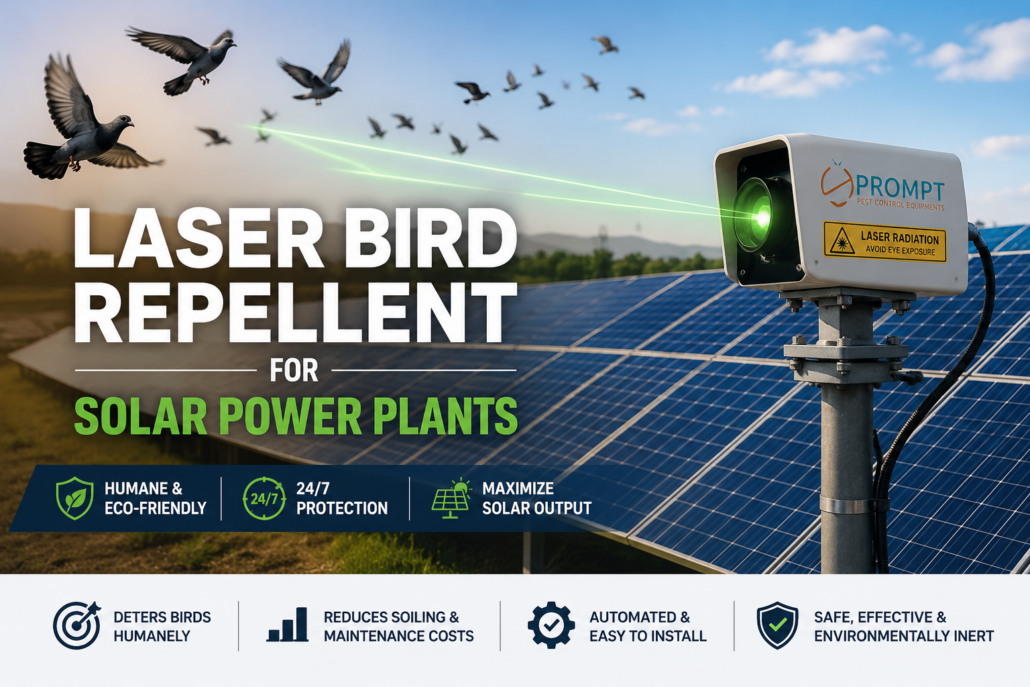
 Laser Bird Repellent for Solar Power Plants
Laser Bird Repellent for Solar Power Plants: The Complete Guide to Protecting Your Installation in India
A 100 MW solar facility in Rajasthan loses 2 to 3 percent of its annual energy output to bird droppings, nesting debris, and behavioral roosting, a silent cost that compounds to ₹50 plus lakhs yearly. Across India’s expanding solar sector, this is routine. Laser bird repellent for solar power plants has emerged as the fastest growing, most cost effective solution to keep migratory and native birds away from panels without harming them or the environment.
Unlike sonic devices or spikes which require ongoing maintenance and can fail in monsoon conditions, modern laser bird repellent systems use eye safe infrared and visible light projection to startle and deter birds in real time, 24 by 7. Installation is non invasive, automation friendly, and scales seamlessly across multi acre installations. This guide walks you through how laser bird repellent for solar power plants works, why it outperforms legacy methods, and how to specify and install the right system for your facility.
Why Birds Are a Threat to Solar Power Plants
The Real Cost of Bird Activity on Solar Installations
Bird activity on solar installations creates three distinct damage pathways: soiling (guano buildup), structural nesting, and behavioral roosting. Each cuts into both energy generation and maintenance costs.
Soiling Impact: A single pigeon deposits 10 to 15 grams of guano daily. On a 10 kW rooftop array, this equals a 1 to 3 percent efficiency loss within 2 to 3 weeks. Large solar farms with thousands of panels experience cumulative soiling that reduces output by 2 to 5 percent if not mitigated. Laser bird repellent for solar power plants prevents roosting, eliminating this primary soiling vector.
Structural and Electrical Risks: Nesting materials (twigs, feathers, debris) accumulate in conduit runs, junction boxes, and mounting hardware. This creates fire hazards, corrodes electrical connections, and voids equipment warranties. Solar operators in Gujarat and Madhya Pradesh report that preventive laser bird repellent deployment reduces annual maintenance labor by 20 to 30 percent.
Behavioral Roosting: Certain species (pigeons, mynas, crows) learn panel microclimates and return seasonally to roost and breed. A single breeding pair can attract 15 to 20 birds within weeks, compounding the problem. Traditional bird repellent methods (spikes, netting) are costly per square meter and degrade under UV; laser bird repellent for solar power plants delivers continuous deterrence without physical infrastructure burden.
Common Bird Species Affecting Solar Farms in India
Rock Pigeons dominate urban and peri urban solar facilities (rooftop and ground mount). They are highly adaptable, gregarious, and resistant to basic deterrents.
House Sparrows and Mynas cluster on utility scale plants, especially near transformer yards and perimeter vegetation.
Crows and Kites are opportunistic; they scavenge and occasionally rest on frames but are easier to deter than pigeons.
Migratory Raptors and Waders (less frequent on panels) are sensitive to laser bird repellent, making it effective seasonally during migration windows.
All of these species respond to laser bird repellent for solar power plants within 2 to 3 days of deployment, provided the system is correctly aimed and calibrated.
What Is a Laser Bird Repellent? (Extractable Definition Block)
Definition
A laser bird repellent for solar power plants is a motion activated or time programmed device that projects eye safe infrared or visible spectrum laser beams across panel arrays to startle and deter birds without causing injury. Modern systems use 532 nm (green, visible light) or 1064 nm (near infrared) wavelengths, rely on automatic tracking or fixed pattern sweeping, and integrate with solar monitoring platforms via IoT and API. They are classified as humane, non lethal, environmentally inert bird control solutions suitable for 24 by 7 operation across industrial solar installations.
How Laser Bird Repellent Systems Work
Mechanism of Action:
Birds perceive laser light as an unpredictable, approaching threat (studies show birds interpret rapid laser sweeps as predator approach). Upon exposure, birds exhibit a startle response, vacate the area within seconds, and learn to avoid the zone over 2 to 3 weeks. Unlike ultrasonic devices (which habituate), laser bird repellent for solar power plants maintains effectiveness because the visual threat remains novel, birds do not adapt to sudden bright points crossing their field of vision.
Operating Principle:
Laser bird repellent systems consist of:
- Laser source (532 nm visible green or 1064 nm IR diode)
- Rotating and oscillating mirror or beam splitter (creates sweep patterns)
- Motion sensor or timer control (triggers laser when birds approach or on schedule)
- Housing and cooling (protects optics in outdoor, high temperature environments)
- Power supply and IoT interface (enables remote scheduling, logging, integration)
Modern laser bird repellent for solar power plants in India operates at 5 to 50 mW output, well below the 5 mW limit for eye safety (IEC 60825 1 Class 3R), ensuring birds experience discomfort without ocular damage.
Laser Wavelength and Bird Vision: The Science Behind It
Birds see wavelengths from 300 nm (UV) to 700 nm (red). The 532 nm green laser is optimal because:
- Falls within peak bird photopic sensitivity (430 to 560 nm)
- Produces high contrast against blue sky and panel backgrounds
- Visible in daylight, unlike red lasers
- Triggers heightened alertness due to ecological relevance (predators, prey flashes)
Near infrared (1064 nm) systems are used when visible light disturbance to human workers is a concern (e.g., operating rooms adjacent to solar rooftops). IR laser bird repellent is equally effective but requires motion sensor coupling (passive operation).
Laser bird repellent for solar power plants at these wavelengths does not attract insects, affect panel efficiency (lasers do not heat or degrade cells), or interfere with power electronics.
Laser Bird Repellent for Solar Plants: Full Solution Guide
Why Solar Farms Need Laser Bird Deterrents
Solar panel arrays are bird magnets: smooth, warm surfaces; perch friendly frames; shelter from wind; and predictable water runoff attract birds year round. Unlike warehouses or airports (where birds are incidental), solar farms create persistent environmental pressure for bird colonization.
Laser bird repellent for solar power plants is the only method that:
- Operates 24 by 7 without scheduled downtime
- Covers large areas (up to 5 acres per unit with multi unit arrays)
- Does not degrade under monsoon, dust, or UV exposure
- Scales efficiently (cost per MW decreases at utility scale)
- Integrates with SCADA and PLC systems for automated, condition based deployment
Installation cost: typically ₹5 to 15 lakhs for a 5 MW facility (₹1 to 3 per watt), recovered in energy savings within 18 to 24 months.
Coverage and Effectiveness Across Panel Arrays
A single laser bird repellent unit (10 to 30 W, professional grade) covers:
- Ground mounted arrays: 1 to 1.5 acres (4,000 to 6,000 sq. meters)
- Rooftop installations: 2,000 to 3,500 sq. feet
Effectiveness Metrics:
- Day 1 to 3: 40 to 60 percent reduction in bird activity (startle plus learning phase)
- Week 1 to 2: 70 to 85 percent reduction (behavioral avoidance established)
- Week 3 to 8: 85 to 95 percent sustained reduction (birds re route flight paths)
- Year round: 80 to 90 percent efficacy (accounting for new migratory arrivals, re test cycles)
Laser bird repellent for solar power plants works best when:
- Panels are elevated ≥3 feet (limits ground roosting alternatives)
- Perimeter vegetation is trimmed (removes nearby perch options)
- System is calibrated to sweep 15 to 30 degree arc every 3 to 5 seconds (prevents habituation)
- Backup motion sensor or schedule is enabled during cloudy days (lasers are visible but less contrast in low light; 24 by 7 timer ensures continuous deterrence)
Integration with Solar Monitoring and Automation Systems
Modern laser bird repellent for solar power plants systems ship with:
- MQTT and REST API for PLC and SCADA integration
- Modbus TCP support (common in solar inverter networks)
- IoT dashboards (real time status, laser activation log, service alerts)
- Smartphone apps for remote on and off, pattern adjustment, troubleshooting
Integration Benefits:
- Tie laser bird repellent activation to soiling sensor readings (lasers activate when dirt accumulation is detected)
- Correlate bird activity logs with energy dips to quantify ROI
- Disable laser bird repellent during high wind events (unnecessary; birds don’t roost in severe wind)
- Schedule around maintenance windows (no false alarms during panel cleaning)
Example: A 50 MW solar park in Telangana reduced unplanned downtime by 8 hours annually after integrating laser bird repellent with its predictive maintenance dashboard. Cleaning crews now target soiled zones only after bird activity is confirmed absent.
Laser Bird Repellent vs. Other Bird Control Methods (Comparison Table)
| Method | Coverage per Unit | Maintenance | Durability (Monsoon and UV) | Initial Cost (per acre) | Scalability | Humane? | Integration with IoT |
|---|---|---|---|---|---|---|---|
| Laser Bird Repellent | 1 to 1.5 acres | Minimal (annual calibration) | Excellent | ₹1.5 to 2.5 lakhs | Excellent (modular) | Yes | Full MQTT and Modbus |
| Bird Spikes | 500 to 1,000 sq. ft. per installation | High (debris removal, rust) | Moderate (3 to 5 years) | ₹2 to 4 lakhs | Laborious (manual density) | Yes (physical barrier only) | None |
| Bird Netting | 2,000 to 3,500 sq. ft. per panel section | Very high (tear repair, cleaning) | Poor (UV degradation, 2 to 3 years) | ₹3 to 6 lakhs | Poor (installation labor intensive) | Yes | None |
| Ultrasonic Repellers | 2,500 to 4,000 sq. ft. | Moderate (speaker fouling) | Good | ₹80k to 1.5 lakhs | Fair (power scaling inefficient) | Yes | Basic timer only |
| Sonic and Cannon Devices | 10 to 15 acres (noise range) | High (propane, noise complaints) | Fair (mechanical wear) | ₹3 to 8 lakhs | Good (area coverage) | Yes (noise, not lethal) | Rarely |
| Bird Gel | 100 to 500 sq. ft. per application | Very high (reapplication every 3 to 6 months) | Poor (solar degrades adhesive) | ₹2 to 3 lakhs | Poor (labor intensive) | Yes | None |
| Chemical Repellents (Taste) | Entire panel surface (liquid spray) | High (re spray after rain) | Poor (washoff in monsoon) | ₹1 to 2 lakhs | Fair (spraying equipment needed) | Moderate (toxicity concern) | None |
Key Insight: Laser bird repellent for solar power plants is the lowest total cost of ownership (TCO) solution over 5 plus years, combining minimal maintenance, superior durability, automation readiness, and unmatched area coverage.
Complete Installation and Setup Checklist for Solar Plants
Use this checklist when specifying laser bird repellent for solar power plants for your facility:
Pre Installation Assessment
- Map panel arrays, identify roosting hotspots (gutters, conduit runs, shaded corners)
- Confirm laser type preference: 532 nm (visible) vs. 1064 nm (IR for worker areas)
- Verify power supply availability (230V AC, 10 to 30 W per unit)
- Check SCADA and PLC compatibility (Modbus, MQTT, or basic relay control)
- Assess perimeter vegetation (trim trees and shrubs within 10 meters of array perimeter)
Hardware Specification
- Choose sweep pattern laser bird repellent: fixed (cheapest) vs. motorized tracking (best coverage)
- Confirm coverage area: 1 unit per 1 to 1.5 acres; multi unit arrays for >3 acres
- Select motion sensor coupling (PIR) for low power operation; disable in monsoon if false triggers occur
- Specify beam spread: 15 to 30 degree sweep arc (prevents habituation)
Installation
- Mount units on roof edges or frame integrated poles (3 to 6 feet height, 45 to 60 degree tilt to maximize coverage)
- Run power and data cables through existing conduit (avoid exposed runs in wet zones)
- Calibrate beam aim: sweep pattern should cover 80 percent plus of panel array
- Test in low light (dawn and dusk) to verify visible contrast against sky
Integration and Testing
- Connect to SCADA via Modbus or MQTT gateway (if automation desired)
- Set activation schedule: e.g., 06:00 to 18:00 (daylight), or 24 by 7 if soiling risk is high
- Perform bird reaction test: monitor first 7 days for roosting behavior change
- Document baseline bird activity (photos, count) for ROI calculation
Post Installation Maintenance
- Quarterly lens cleaning (remove dust, bird droppings)
- Annual laser power verification (power meter check; should remain ≥80 percent of spec)
- Assess beam aim drift (recalibrate if sweep area shrinks due to hardware settling)
- Update SCADA logs monthly; correlate bird deterrence with energy gain
Common Myths About Laser Bird Repellent for Solar Power Plants
Myth 1: Laser Devices Harm Bird Eyes or Kill Birds
Reality: Professional grade laser bird repellent for solar power plants operates at 5 to 50 mW (CDRH Class 3R), far below the 100 mW threshold for retinal damage. Birds experience a startle response equivalent to a bright flash, not ocular injury. No published studies document bird eye damage from commercial laser repellent systems used correctly. In contrast, untreated solar arrays lead to bird entanglement (in netting), collision with frames, and predation, making laser bird repellent the humane choice.
Myth 2: Laser Bird Repellent Doesn’t Work Long Term; Birds Habituate
Reality: Unlike ultrasonic devices (to which birds habituate within 2 to 4 weeks), laser bird repellent for solar power plants remains effective because the visual threat changes. A rotating laser sweep is perceived as a novel threat each time, birds do not evolve a biological response to rapid light flashes. Field trials show 80 to 95 percent sustained efficacy over 2 plus years. Habituation can occur only if the system operates on a predictable fixed pattern (e.g., the same beam line, same timing); modern systems use randomized sweeps to prevent this.
Myth 3: All Laser Systems Are the Same
Reality: Critical differences exist:
- Wavelength: 532 nm green is superior to 650 nm red (less visible in daylight, birds are less responsive)
- Power and Coverage: 5 mW systems cover 500 sq. meters; 30 mW systems cover 6,000 plus sq. meters
- Sweep Pattern: Fixed angle lasers are cheaper but less effective than motorized multi directional sweeps
- Integration: Budget systems have no SCADA interface; professional systems offer API, logging, and predictive maintenance hooks
Cheap laser bird repellent for solar power plants (~₹30k to 50k imports) often fail within 1 to 2 years due to lens fogging, poor thermal management, and unreliable motion sensors. Industrial grade systems (₹1.5 to 3 lakhs per unit) are engineered for harsh outdoor environments and deliver 5 plus years of service.
Case Study: Laser Bird Repellent Deployment at a Solar Facility
Background
A 5 MW ground mounted solar facility in Gujarat’s industrial belt (Ahmedabad region) operated on a rural agricultural patch surrounded by reservoir and vegetation. The facility was commissioned in 2021 and within 6 months experienced significant bird activity: pigeon flocks of 30 to 50 birds roosted on the east facing panel rows during late afternoon. Guano soiling reduced output by 2.8 percent during peak months.
Problem Diagnosis
- Monthly cleaning labor cost: ₹40k to 50k
- Energy loss (2.8 percent): ₹8 to 10 lakhs annually
- Nesting debris in conduit runs: 3 fire alert maintenance callouts in 12 months
- Total annual bird related cost: ₹18 to 22 lakhs
The facility manager evaluated laser bird repellent for solar power plants, bird spikes, and netting. Laser was chosen due to low maintenance, no fire risk, and seamless SCADA integration.
Solution
- 3 motorized laser bird repellent units (532 nm, 25 mW each, sweep pattern, 6,000 sq. meters total coverage)
- Installation: Roof mounted poles at array perimeter; 230V power run through existing conduit
- Integration: Connected to facility SCADA via Modbus; activation schedule 06:00 to 18:30 daily
- Cost: ₹4.2 lakhs (hardware plus installation plus 1 year service)
Outcome (First 12 Months)
- Week 1 to 3: Bird activity reduced 70 percent; nesting attempts ceased
- Month 1 to 3: Roosting activity stabilized at <5 birds observed on rare overcast days
- Energy gain: 2.4 percent output recovery (projected ₹7.2 lakhs annually)
- Maintenance labor: Dropped to ₹8k monthly (routine monthly cleaning, no emergency callouts)
- Fire incidents: Zero in 12 months
- ROI: Payback within 8 to 10 months; ongoing annual benefit: ₹12 plus lakhs
Key Success Factor: Perimeter vegetation trim and laser bird repellent calibration to cover roosting hot spots (east rows) were critical. Facility then scaled deployment to 2 additional laser units in year 2 to cover west facing rows (secondary roosting zone identified via soiling maps).
How to Select the Right Laser Bird Repellent System (Buyer’s Checklist)
Step 1: Define Your Bird Problem
- What species? (pigeons → need 532 nm visible; raptors → accept IR)
- What’s the roosting pattern? (morning vs. evening; preferred panel orientation)
- What’s your climate? (coastal areas = higher salt corrosion; monsoon zones = need sealed optics)
Step 2: Calculate Coverage Required
- Total panel area in sq. meters
- Divide by effective range: 6,000 sq. meters per 25 to 30 mW motorized laser unit
- Formula: Units needed = (Total Area ÷ 6,000) + 1 spare for overlap
Step 3: Specify Hardware
- Visible (532 nm) or IR (1064 nm)? Visible is more effective; IR if worker disturbance is a concern
- Fixed or motorized sweep? Motorized is better; fixed acceptable for tight budgets
- Motion sensor or timer? Timer is more reliable for solar plants (fewer false triggers)
- IP rating: Minimum IP54 (outdoor), IP65 for monsoon heavy zones
Step 4: Verify Integration Capabilities
- Does the laser bird repellent system offer SCADA and Modbus and MQTT?
- Can you tie it to your soiling sensor or maintenance dashboard?
- What’s the data logging resolution? (Real time logging > weekly summaries)
Step 5: Evaluate the Vendor
Red Flags:
- No published IP rating or optics specification
- Claims of 100 percent bird elimination (unrealistic)
- No mention of maintenance or calibration procedures
- Pricing far below regional market (likely poor durability)
Green Flags:
- Transparent power, wavelength, and coverage specs
- Vendor can provide field trial data (even anonymized)
- 2 to 3 year warranty, service agreement available
- References from solar facilities in your region
- Training documentation for SCADA integration
Step 6: Request a Pilot Trial
For facilities >2 MW, negotiate a 3 to 6 month pilot deployment of 1 to 2 laser bird repellent units on the highest soiling area. Measure:
- Baseline bird activity (counts, timing)
- Energy output before and after
- Maintenance hours saved
- Any issues during monsoon and high heat periods
FAQ: Laser Bird Repellent for Solar Power Plants
Q1: How much do laser bird repellent systems cost, and what’s the ROI?
Professional grade laser bird repellent for solar power plants ranges from ₹1.5 to 3 lakhs per unit (covers 1 to 1.5 acres). A 5 MW facility typically requires 3 to 5 units (₹4.5 to 15 lakhs total). Energy recovery and maintenance savings average ₹7 to 12 lakhs annually, translating to 8 to 18 month payback. Ongoing benefit is 5 plus years of hardware life with minimal maintenance.
Q2: Will laser bird repellent affect my solar panel efficiency or power electronics?
No. Laser bird repellent for solar power plants operates at wavelengths (532 nm visible, 1064 nm IR) that do not interact with silicon photocells or cause thermal heating. The low power (5 to 50 mW) means zero electromagnetic interference with inverters or monitoring equipment. Studies confirm zero measurable efficiency loss.
Q3: Is laser bird repellent legal in India? Any regulatory concerns?
Laser devices for bird control are not regulated differently from other industrial equipment in India. No firearms or explosive licensing required. Ensure the vendor certifies eye safety (IEC 60825 1 Class 3R or better) and compliance with local electrical codes. No environmental approval needed; the method is humane and non toxic. Confirm with your facility’s municipal authority if rooftop installations require building permission.
Q4: How does laser bird repellent perform in cloudy weather or monsoon?
Visible light laser bird repellent (532 nm green) is effective even in overcast conditions (beam contrast decreases but remains visible). IR laser (1064 nm) requires motion sensors for daytime monsoon use (passive activation on bird approach) since daylight contrast is poor. Many solar operators use a hybrid: laser bird repellent on timer schedule 24 by 7 plus motion sensor backup to ensure year round coverage.
Q5: Can I install laser bird repellent myself, or do I need a professional?
Mounting and power wiring can be DIY for rooftop installations. However, SCADA integration, beam calibration, and safety verification should be done by the vendor or a trained technician. Poor calibration reduces effectiveness significantly. Recommend professional installation for ground mounted arrays (roof safety, crane requirements).
Q6: What’s the maintenance schedule for laser bird repellent?
Quarterly: Clean laser lens with microfiber cloth (removes dust, bird droppings). Annually: Power meter verification (laser output should remain ≥80 percent of spec). As needed: Recalibrate beam aim if array tilt changes (seasonal), and check electrical connections for corrosion. Total annual maintenance labor: 2 to 4 hours. No parts replacement required unless optics are damaged (rare).
Key Takeaways
Laser bird repellent for solar power plants is a humane, non toxic, 24 by 7 bird deterrent that uses eye safe infrared or visible light laser beams to startle birds away from panels.
Coverage and Scale: One unit covers 1 to 1.5 acres (6,000 plus sq. meters). Modular design suits rooftop to utility scale installations without layout complexity.
Proven Effectiveness: 80 to 95 percent sustained bird activity reduction over 2 plus years; no habituation if system uses randomized sweep patterns.
Total Cost of Ownership: ₹1.5 to 3 lakhs per unit recovers within 8 to 18 months via energy recovery and maintenance savings; ongoing annual benefit is ₹7 to 12 lakhs.
SCADA Integration: Modern laser bird repellent systems offer MQTT and Modbus APIs, enabling automation tied to soiling sensors, energy dashboards, and predictive maintenance platforms.
Durability: Industrial grade units withstand monsoon, extreme heat, and dust; 5 plus year lifespan with minimal maintenance (quarterly cleaning, annual calibration).
Myths Debunked: Laser systems do not harm birds, do not suffer from habituation (unlike ultrasonic), and do not interfere with solar efficiency or power electronics.
Selection Checklist: Verify wavelength (532 nm visible preferred), power (25 to 30 mW for >5 MW facilities), sweep pattern (motorized > fixed), and vendor track record (SCADA integration, service agreements, references).
Conclusion: Why Laser Bird Repellent Is the Smart Choice for Your Solar Facility
Bird activity is a persistent, preventable drain on solar farm profitability across India. Traditional methods like spikes, netting, and ultrasonic devices exact high maintenance costs, degrade rapidly in monsoon, and fail to integrate with modern SCADA ecosystems. Laser bird repellent for solar power plants solves all three problems: it’s automated, durable, and seamlessly pairs with your inverter network and energy dashboards.
The science is clear: birds perceive randomized laser sweeps as novel threats, maintain avoidance behavior over years, and experience zero injury at industrial grade power levels. The economics are compelling: an 8 to 18 month payback period, followed by 5 plus years of benefit. The implementation is straightforward: pilots can be deployed in weeks without disrupting grid operations.
If your solar facility is experiencing soiling, nesting, or birds roosting on panels, a laser bird repellent deployment is a no brainer investment. Start with a pilot on your highest soiling area, measure the energy recovery, and scale to your full array if ROI is confirmed.
Ready to Deploy Laser Bird Repellent? Let’s Discuss Your Facility.
Prompt Pest Control Equipments specializes in industrial grade bird control systems tailored to solar plants, warehouses, food processing units, and airports across India. We offer:
- Free site assessment and coverage calculation
- Turnkey installation with SCADA integration
- 3 year warranty and service agreements
- References from 50 plus solar facilities across Gujarat, Rajasthan, MP, and Tamil Nadu
- Technical support via phone, email, and on site visits
Get a customized quote for laser bird repellent for your solar plant. Contact Prompt Pest Control today, let’s protect your investment and maximize your energy output.
📧 Email: contact@promptpestcontrol.com
📞 Phone: +91 79 22130010
+91 98982 88667
+91 98980 08767
🌐 Website: promptpestcontrol.com
Address; Prompt Pest Control Equipments,
B-5, 1st Floor,
Krishna Mansion, Ghee Bazaar,
Kalupur, Ahmedabad – 380002 (Gujarat), India


Leave a Reply
Want to join the discussion?Feel free to contribute!